The Lie You Learned to Survive: How the False Core Shapes You—and How Awareness is the Antidote to Unravel It
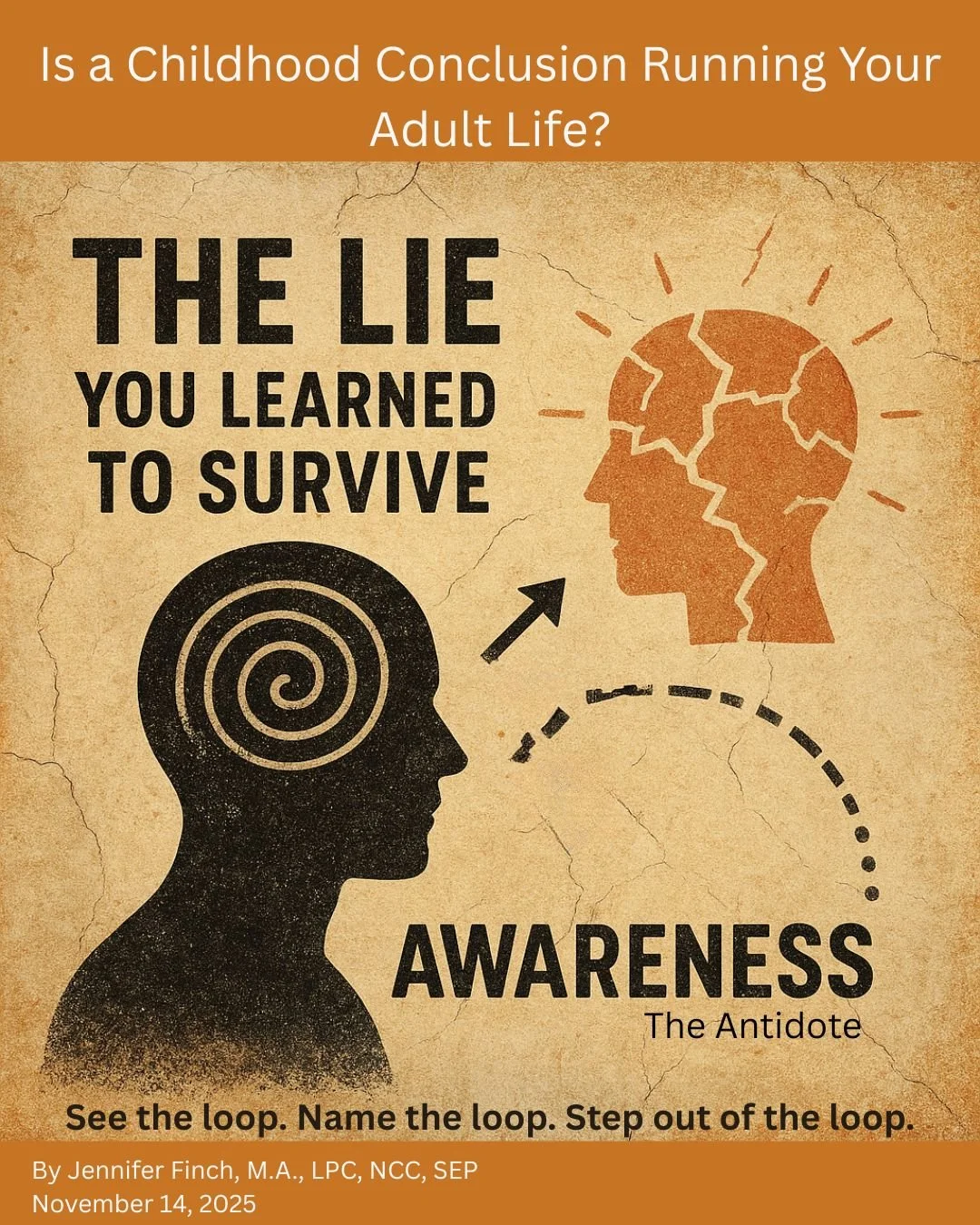
(*If you stick around to the end, there is a free worksheet to help you uncover your false core and simple instructions on how to find freedom from it. **And although it might be tempting to jump right to it and skip ahead, it’ll make a lot more sense if you know what you’re looking at first. Your call. But as Sri Nisargadatta Maharaj says, “You can’t let go of something until you first know what it is.”)
In the work I teach, particularly through Quantum Psychology, the map by Dr. Stephen Wolinsky, and the Realization Process, as developed by Dr. Judith Blackstone, we explore how identity is shaped by early conclusions formed under stress, trauma, and/or overwhelming circumstances. We have constructed adaptive identities that we built to protect ourselves, but that ultimately obscure who we really are. However, until we recognize and deconstruct these early conclusions, they will continue to fundamentally drive our psychology in ways that are, at best, wildly unhelpful and, at worst, completely ludicrous. We repeat the same destructive patterns in what I call a “dukkha loop” — a self-perpetuating and ceaseless ouroboros of suffering. A circular pattern where our trauma reinforces itself with the enthusiasm of a snake committed to eating its own tail.
Understanding the False Core and False Self
In Dr. Wolinsky’s work, he describes what he calls the false core. Psychology and other traditions have their own labels for it, such as organizing principles and implicit maps. It is a single childhood conclusion formed at the moment of overwhelm or fragmentation. It is not a personality flaw. It’s a conclusion. A child, overwhelmed and under-resourced, interprets a moment of fragmentation (i.e., an event that occurred too quickly or too suddenly for the child to process, or a long-term, chronic stressor that persisted too long with insufficient support and without adequate protection, or a mirroring of a caregiver’s false core) and makes meaning out of it. Not because the interpretation is accurate, but because meaning-making is what the nervous system does when it needs order. In general, children have very malleable and susceptible minds that make them incredible observers, but also terrible interpreters.
Most people carry a single, central conclusion. These are the major false cores adapted from Wolinsky:
“I am alone,” “There must be something wrong with me,” “I am worthless,” “I am not enough,” “I cannot do,’ “I am inadequate,” “I don’t exist,” “I am unsafe,” “I am unlovable,” “I am incomplete,” “I am too much,” “I don’t matter,” or “I am powerless.”
I would also like to add here what I am observing in my private practice, and what I am calling “Belief Epidemics.”
Here are some of the greatest cultural hits of belief epidemics:
“I am not being seen, heard, and validated, and I need that praise or recognition to be okay.”
“I can’t handle this.”
“I’m too overwhelmed,” or “I am traumatized.”
“I’m too triggered.”
“I’ll never change.”
(Cultural belief epidemics create a false self that can operate differently in that, instead of overcompensating to mask or cover the false core, they actually work to prove it, reinforcing the very identity we most need to outgrow. Through socially sanctioned scripts, they can simultaneously strengthen the false core and the false self by normalizing them, making the wound feel accurate rather than distorted. They can, in this way, be even more dangerous, feeling legitimate, even virtuous, and can keep us tethered to it.)
To get underneath, you can simply ask: Who am I if I don’t get validation, praise, or recognition? What happens if I am not seen or not heard? Am I still me? Or not me? Or we can ask: who am I if I am not triggered? Or who am I if I can handle this? Etc. If answering these makes you shaky, then we can work to go deeper into uncovering the true false core that is powering the belief epidemic.
It is pertinent to know that the false core isn’t trauma itself; it’s the meaning the child makes and constructs in response to an overwhelming experience to survive it. It is an unconscious, unprocessed, “uncooked seed” of psychological material that hasn’t been “cooked” yet by awareness. This conclusion becomes the organizing principle of identity. Everything perceived afterward reinforces it. This becomes the internal axis around which identity begins to organize. It is preverbal, somatic, and immediate. It is felt long before it is thought. And as Wolinsky emphasizes, it becomes the unconscious reference point for the rest of your life. Yikes! The good news, however, is that once it becomes conscious, it becomes incredibly simple to work with through his framework of Quantum Psychology.
Let’s continue…
The False Self: The Architecture Built to Protect the False Core
Once the conclusion (the false core) forms, the nervous system builds an entire behavioral and perceptual structure to ensure that the original wound never gets touched again. Perk your ears up on that, because that is a hard truth pill to swallow. Everything you have done, created, or are attempting to avoid reinforces this idea.
This is the false self:
the over-functioner
the perfectionist
the caretaker
the hyper-rational one
the fixer
the avoider
the pleaser
the martyr
the one who never rests
the one who never needs
the one who always knows
Each strategy is intelligent. Each one is survival. And each one works—until it doesn’t.
The false self is the compensation for the false core. Once the false core forms, the child builds a false self. A strategy and a set of behaviors to prevent ever feeling that original conclusion again. It can be understood as an identification of self that has become ingrained and embodied, leading one to believe one cannot exist without it. It feels as if it IS them.
Classic examples from my psychotherapy practice look like: over-functioning, caretaking, perfectionism, emotional withdrawal, or becoming the one who always adjusts.
Here’s how the false core and false self collaborate:
If the false core is “I am powerless,” the false self becomes: hyper-competent, over-functioning, controlling, over-prepared.
If the false core is “I am unworthy,” the false self becomes: the caretaker, the achiever, the over-giver.
If the false core is “I am alone,” the false self becomes: the pleaser, the fuser, the one-who-always-adjusts.
The false self is not who you are. It’s a reflex.
It can take some time to figure out your false core and what drives your false self. Remember, the false core is an uncooked seed, hidden and buried deep, running unconsciously from behind the portcullis. Most of us don’t notice it until life keeps repeating the same discomforts, and we finally decide to look closer.
If you read through the above list, at first you might catch yourself saying, “That’s me,” or “I don’t do that.” That’s a start. But be patient in finding your root. That’s the moment you can trace back any painful incident in your life to the same unconscious source. Your false self will reveal how you did it by bulldozing forward in your life, trying to prove the opposite.
· Prove there is nothing wrong with me, and act as if I am perfect.
· Prove I am not worthless, and act as if I have value or worth.
· Prove or act as if I am an overachiever to overcompensate for “I cannot do.”
· Prove I am not inadequate and act as if I am overly adequate.
· Prove or act as if I exist or am something.
· Prove or act as if I am connected to overcompensate for “I am alone.”
· Prove I am not incomplete and act as if I feel complete.
· Prove I am not powerless and act as if I am powerful.
· Prove I am not loveless and act as if I am lovable.
You get the gist. You can see how there is a shadow side under each false self, leading you to a false core. The false core is what was imprinted as a result of a survival response, and the false self began laying down tracks to cover it up. I call this “Velveteen Rabbit syndrome:” chasing proof of our existence while inadvertently reinforcing the illusion that we aren’t already here. It deepens the false core that we aren’t already enough. We don’t need validation, or whatever the false core feels we need, to be ourselves or to feel real.
This is a limitation and a reverberation.
In the end, the limitation isn’t the world, or the belief that we aren’t getting our needs met—it’s the false-self created from a false-core.
And the overcompensation becomes the proof of it. It is interesting to me how often jobs and careers seem to choose individuals as well—-another form of evidence to prove we are not the false core and shall keep it hidden at all costs.
Both the False Core and False Self Are “Mind-Generated Movies.”
Together, they act as a single unified construct: the false-core-false-self. Again, both layers are protective, and both are automatic. And in that way, they are indeed intelligent, but not so intelligent that they cannot see that you most certainly can live without them. And that they are not who you are.
Collaboratively, the false core and false self act as a kind of lens, or a trance, through which we perceive both the world and our place in it, as well as how we imagine the world views us. Everything we experience gets filtered through this inner storyline. If the false core whispers “I’m worthless” or “I’m inadequate,” then every moment, every interaction, is interpreted through that trance.
Wolinsky would say something like this:
The false core is the script. The false self is the actor. And neither are actually you. You’re not trying to “change” them. You’re learning to see the projector.
The goal of this work is not to modify either structure or make any significant changes. This might come as a surprise. However, if we attempt to fix or change it, we ultimately end up adding another layer of falseness over the false self, over the false core. And the onion peel begins to grow outwardly. We just keep getting further away from the uncooked seed and therefore cannot see it. It becomes dormant and unconscious. But what we fear, what is unknown, underneath all these onion peel layers, is not broken. And it doesn’t need fixing or changing. It is already unfragmented and whole.
Let me explain differently.
Many psychologies will have us swap our beliefs, change mindsets, use reframing to shift our perspective, and then express them verbally, for example, “I am worthless,” swapped to “I am great or I am worthy.” This can help. Initially. Fake it until you make it can be a useful motto. But we are still, of course, living from the same self-referentiality of “I am worthless,” although now we are covering it up with another layer further from the truth. We have just rushed to replace it with something shinier. It’s a basic substitution. But that’s just another layer of resistance.
The further we move away from the core, the more complexity we encounter, and we try to run away from it faster and more cleverly. But it doesn’t work. Usually, the very act of resisting, replacing, ignoring, or trying to push away reinforces it.
The uncooked seed will still consequently drive behavior. And no matter how artfully we outrun it, an uncooked seed keeps sprouting. Left unexamined, it germinates underground. Sooner or later, it drives behavior in ways that eventually surface as compulsions, addictions, and patterns we can no longer ignore. These become behaviors that bear little resemblance to the original wound yet grow directly from it. They may even seem irrational on the surface, but will make perfect sense when traced back to their root—the very false core we’ve worked so hard not to feel.
In Buddhism, this pattern is referred to as samskara, which is subtle impressions that accumulate and settle into our psyche and body. They hold us in a position that we remain stuck in, shaping our reactions long after the original experience is gone. We can think of them as inherited grooves in consciousness; they are familiar, automatic, and can be quite persuasive. They only lead to a distorted perception of how we see ourselves and the world, and act as an energy block. They are habitual tendencies that recreate the same reactions and become seeds of future thoughts, emotions, and behaviors.
They often manifest physically as tension, discomfort, diffuse pain, digestive problems, or symptoms that don’t align neatly with any medical condition. They can be familiar—a pattern you swear you’re done with.
We all know someone who serves as a perfect case study: the “I’m fine, everything is FINE” person whose tone alone tells you that absolutely nothing is fine. That brittle positivity is the front door of a samskara—an internal imprint holding them in place while pretending everything is perfectly under control. But samskaras aren’t always as loud or brittle as “toxic positivity.” Sometimes they hide in subtler forms—a sudden change of subject when things get close, a chronic over-focus on helping others, a perfectly curated competence that never cracks. Some slip under the radar, or even get applauded by our culture, like chronic busyness, a compulsive need to be useful, intellectualizing every feeling, or overexplaining. Sometimes I describe it as what I call “rigid neutrality”—the “nothing bothers me” professional, or the helper who never receives. Or the one who stays “steady” by never actually showing up. They pass as normal, even admirable, or socially rewarded, and they can read as maturity, not avoidance. This makes them harder to spot and even harder to unhook from. But as much as these patterns look functional from the outside, they are just as binding. Internally, they keep the person circling the same terrain without ever touching the root. The false core imprint driving them is the same.
As a somatic practitioner, I’m trained to notice the subtle and to see the discreet. They can appear as a tightening in the throat, a polite smile that conceals pain, masked as composure. Or maybe a “please and appease” arrives a little too quickly than what the situation calls for. Sometimes it shows up as sudden exhaustion, like a yawn right where anger should be. Or a constriction or subtle recoil when intimacy edges too close and signals the topic is taboo. I see it, too, in the practiced equanimity of what I call “yoga rigid,” where discipline replaces feeling—a lifetime spent excelling at things, perfecting practices that never actually reach or touch the heart. This is colloquially known as the disciplined “spiritual bypass.” The imprint stays active, even when the strategy is exquisitely understated.
How is your false core speaking through your body right now? Through tension, withdrawal, boredom, composure, busyness, or perhaps fatigue? Can you sense how your own early conclusion expresses itself somatically?
How the Loop Sustains Itself
So, we are learning how the false core (the conclusion) creates the false self (the survival strategy). And how the false self reinforces the false core by generating the same emotional landscapes that originally shaped it. This is why insight won’t break the cycle. You can understand the pattern perfectly and still live inside it. The loop persists because it is embodied.
When we replace or swap out mental constructs, we are only then looking at constructions from a construction, and there will be no real change. We cannot just change our perspective or alter a belief. We have to go the opposite way, by deconstructing what is underneath it. We have to take a very close look at it to reveal its basis and nature, and uncouple it from our somatic and subtle bodies. Thereby, the constructs we have built on top and that “lie above” can be dissolved. We need to be free of contradictions, and when we are, we are free of conflicts within ourselves.
Deconstruction Happens Through Tracking the Loop
Wolinsky’s entire project is built around one central idea: The “self” you think you are is a loop of conditioned misperception. It’s not real. And it never was.
He doesn’t try to improve it. He doesn’t try to heal it. He doesn’t want you to ignore, replace it, or cover it up. He doesn’t want you to try to get rid of it, which just tightens its grip. In fact, just the opposite. He wants us to expose it. When we see it for what it really is, it dissolves. The work is designed to help you recognize the false core, feel, and identify where it shows up in your body, and return to the stable awareness beneath it.
His method is brutally simple:
Step 1: Identify the false core conclusion
The essential sentence. The survival belief. See the conclusion.
Step 2: Track the behavior that compensates for it (false self)
“How do I organize myself around never feeling this again?” See the strategy. Trace every thought, emotion, and reaction back to its root.
Step 3: See the loop in real time
This is the key: we are not analyzing it, we are not processing it as a memory, but rather seeing it as it unfolds and fires in the moment. Notice the loop in real time. Observe the associations, and notice how much of your life has orbited around that single idea.
Step 4: Separate awareness from the loop
Every feeling, every fantasy has been organized around this one thing, and once we recognize that truth, then we can dismantle it through inquiry. Could you let it go? And know you are still you, only freer. Gradually, work by sitting with it, seeing it for what it is, until it begins to fall away. You were a child, doing your best to make sense of your experiences. These aren’t permanent states or personalities. We don’t just experience event X; we appraise it and make meaning out of it (“this is dangerous”, or “this is growth”). That appraisal becomes a lens, a habit, a belief system, and eventually, we cultivate it as part of our false self. Then we keep looking for proof, to well, prove it, so we can say, “See, I told you I’m not good enough!” Alternatively, we can overcompensate by proving we are good enough, but underneath lies a wobbly self with limited self-confidence or a lack thereof.
Once we understand how everything is organized around this one structure, we can go beyond the conceptual nature of it, thus experiencing liberation. You won’t dissolve if you let it go. You won’t disappear. You won’t evaporate into thin air. You won’t stop existing. And there will be ground beneath your feet. False cores aren’t permanent. They’re formed through how we interpret experience. And then every experience after that in perpetuity. Until we become conscious and choose to step out of the loop.
We will find meaning and begin to recognize how our whole life, our false self, and all the mindsets that have been stapled to it, have tried to overcompensate, even in insidious attempts to cover it up and conceal it. Healing and transformation come from gently uncovering it through awareness. We cannot do this without attuning to awareness.
Shift attention to the awareness that sees the loop. This is Wolinsky’s quantum move: Everything the mind creates—thoughts, memories, sensations, identity—arises in awareness, but awareness itself is not the loop. Not the body state. Not the emotion. Not the belief. Not the compensation.
The field of awareness is a steady, unfragmented space in which all of this arises and dissolves.
He calls this the no-state state or pure seeing. Dr. Blackstone calls this Attunement to Fundamental Consciousness.
When you see the loop from or as awareness, the loop dissolves. When you experience the loop from awareness rather than from within it, the false core loses its authority and the false self loses its position.
This is deconstruction and the final move. We return to what is aware of all of this from the get-go. We are beyond the body sensation, the beliefs, the compensations, and even what once convinced us was a hardened personality. We are seeing ourselves and the work from the awareness in which all of this appears.
This is liberation at the level of identity. That’s the “real you.” It is unconstructed and non-conceptual. It is “prior to” a constructed identity. It is “prior to” trauma. It is “prior to” the false core. And “prior to” the false self. We are returning and going back to where we came—the before.
The Body is Central
This is where embodiment and nonduality converge. We can immediately track the false core to: constriction, reflexive tension, autonomic survival responses, dissociation, fragmentation, etc. The false core is felt before it is a thought. So we can find it through sensation, not any conceptualized story.
The false self takes root through repetition, social reinforcement, and our physiology. The brain learns what “works.” If avoidance once kept you safe, it becomes your default. Before long, identity forms around it—I’m the kind of person who… and the loop is complete.
It may take some time to unwind and break free from these patterns. It takes awareness, not avoidance. You can’t meditate or mantra them away. You have to be willing to look directly at them and acknowledge everything that is there. Once again, as Nisargadatta Maharaj said, “You cannot let go of something until you know what it is.”
He Doesn’t Fix the False Core — He Shows It Never Had Reality
In the deconstruction process, awareness is primary. We are never trying to “heal” the false core. We are exposing it and seeing it as a construct that was never real. And we outgrow our identification with it.
Awareness is the heat that transforms the uncooked material of our psyche. Without awareness, those raw, repressed, unprocessed false cores keep sprouting the same poisonous fruit. They repeat, recycle, and run the show from behind the curtain.
But when we bring awareness to them, the false core starts to lose its grip on us, and we regain choice and control over our responses to life. We see that the stories we’ve been living out of—I’m not enough, I’m unlovable, I’m too much—are not the truth of who we are. They’re the conditioning that keeps us from remembering it.
In classic deconstruction language:
The false core isn’t who you are.
It’s a conclusion based on a child’s level of consciousness,
with a child’s nervous system,
misinterpreting a moment of overwhelm.
Its power comes from identification. Remove the identification, and it collapses. When we stop placing unconscious attention on the false core/false self, energy becomes available again, and presence and wholeness return. What’s left isn’t the armored version of us, or the reactive version either. Or the one who is scared to grow up and mature, or let go of their organizing principles or structural defense mechanisms, addictions, or what have you, all of which were operating out of a single drawn conclusion. What we uncover is the real you, unobstructed and with a clear view of self and the world.
When you stop organizing your identity around these reflexes, you regain access to internal steadiness, clarity, and genuine choice. This is how real change happens, through embodied awareness. This is not self-improvement. What we are unveiling is the self that didn’t need improving in the first place. You’re not upgrading yourself to a polished, better version; you’re uncovering the self that existed before the false core started running the show and trapped you in its circular logic. That self, underneath, was whole and intact all along.
WORKSHEET
PRACTICE EXERCISE — “TRACKING THE LOOP”
Tracking the Loop: A Wolinsky-Informed Somatic Awareness Practice
This practice helps you recognize the underlying conclusion (false core) and the compensatory strategy (false self) in real time, which shape your reactions, behaviors, and internal states. This is not an idea, but a lived experience, and this practice builds clarity, embodiment, and awareness.
Step 1 — Pause and Notice
Choose a moment of discomfort, activation, or emotional constriction.
What situation or interaction brought up discomfort or reactivity?
(Brief description)
Don’t analyze it. Just notice:
What’s happening in your body?
What’s tightening?
What’s pulling?
What’s collapsing or bracing?
What sensations do you notice in your body right now?
Check all that apply:
☐ Tightness
☐ Heat
☐ Numbness
☐ Pressure
☐ Pulling inward
☐ Bracing
☐ Restlessness
☐ Shallow breath
☐ Other: ________________________________________________
Where do you feel it most?
Step 2 — Identify the False Core Sentence
Ask yourself gently:
“What internal conclusion about myself is showing up and emerging here?”
Let it surface organically. It’s usually one sentence.
Choose or write your own:
☐ I am alone.
☐ I am not enough.
☐ I am unsafe.
☐ I am powerless.
☐ I am too much.
☐ I don’t matter.
☐ There must be something wrong with me.
☐ I am worthless.
☐ I cannot do.
☐ I am inadequate.
☐ I don’t exist.
☐ I am unlovable.
☐ I am incomplete.
☐ Other: _____________________________________________
Write the exact sentence that feels most true in this moment:
Step 3 — Identify the False Self Strategy
Next, ask:
“What am I doing right now to avoid feeling that conclusion?”
This might be:
overthinking
fixing
explaining
withdrawing
appeasing
performing
controlling
shutting down
indulging
Check any that apply:
☐ Overthinking
☐ Fixing
☐ Pleasing
☐ Withdrawing
☐ Over-functioning
☐ Explaining
☐ Controlling
☐ Working harder
☐ Shutting down
☐ Performing competence
☐ Staying busy
☐ Other: ______________________________________________
Describe the behavior or strategy you notice:
Step 4 — See the Loop
Bring both pieces into view at the same time:
the conclusion
the strategy
the cycle between them
This is the loop.
How do the false core and false self reinforce each other?
(Brief reflection)
Example prompt:
“When I believe ________, I immediately try to ________, which keeps me from ever feeling ________, so the belief stays intact.”
Step 5 — Shift to Awareness
Instead of trying to change the loop, gently bring attention to the awareness that is noticing all of this.
See it from the awareness that is noticing it.
Ask:
“What is aware of this pattern right now?”
Feel the shift.
It’s usually subtle, gentle, spacious, and immediate.
What changes when you observe the loop instead of being inside it?
☐ More space
☐ Less urgency
☐ Clearer thinking
☐ Softer body sensations
☐ Emotional distance
☐ Greater steadiness
☐ Insight arises
☐ Other: ______________________________________________
Describe what you notice:
Step 6 — INTEGRATION –Rest Here
What becomes possible when you see this loop clearly?
Is there one small action or shift that feels available now?
The loop loses its power when you see it from awareness rather than from within it. No pushing. No striving. No controlling. Just seeing.
This is the deconstruction. This is where the false core loosens and the false self softens. This is where identity becomes less rigid and embodiment becomes more grounded.
NOTES / INSIGHTS
(For anything that surfaced but didn’t fit elsewhere.)