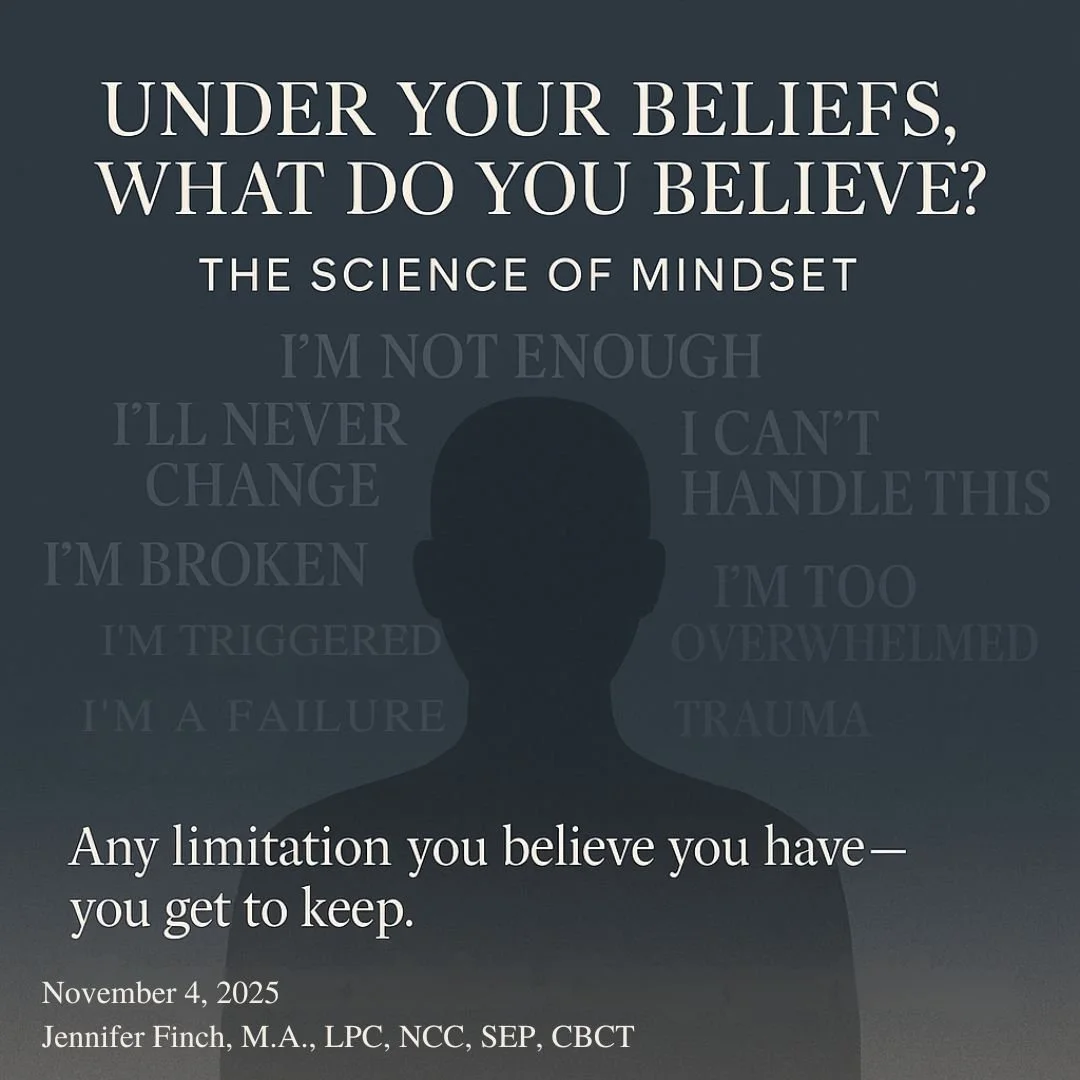
Under Your Beliefs, What Do You Believe?The Science of Mindset
The Buddha is commonly attributed with saying, “We are what we think. All that we are arises with our thoughts. With our thoughts we make our world,” or the shorter, “The mind is everything. What you think you become.”
In this brief article, I aim to examine this fundamental Buddhist Principle and ask: Do our thoughts really have the power to shape our entire reality and our whole state of being? Is this what all the influencer hype is about? All it takes is holding a “positive attitude.”
What I discovered on this quest may challenge your perceptions of yourself and the world around you. Before we get under the hood of our thoughts that are so-called “making our world,” I ask very importantly here:
What do you believe, under what you think you believe?
The Science of Mindset
Psychology isn’t rocket science—it’s closer to gardening. What you water grows. So, yes, it’s true. Your beliefs undoubtedly are the seeds shaping your worldview. This should cause pause and provoke a contemplation about what exactly we are watering.
But whatever we are watering, it goes beyond mere energy waves of our fickle thoughts. A new wave of science is revealing that what we believe can literally alter not only our day-to-day lives and our worldview, but also our biochemistry, neurology, and the totality of our psychological makeup. Our well-being literally depends on what we think. In a culture where we are force-fed countless beliefs in a single day, how many of us really examine what it is that we actually believe under them? What is it that drives our (not anyone else’s) belief systems?
Thanks to researchers like Dr. Kelly McGonigal, from Stanford, and Dr. Alia Crum at Columbia University, who are at the forefront of a new emerging field of research in what psychologists call mindsets. The mindset we carry affects how our neurons fire, how our hormones are balanced, and how our immune system functions.
Because people believe in jest that they don’t have the attention span anymore to read an entire article, let’s cut right to it:
Any limitation you believe you have, you get to keep. And now we know with conviction that our biology will follow your lead.
In her book The Upside of Stress, Dr. McGonigal cites countless studies showing that people who believe stress is harmful are more likely to die prematurely—not because of the stress itself, but because of what they believe about it. Those who view stress as a sign of meaning, motivation, or growth actually live longer, healthier lives. Same stress. Different belief. Radically different outcomes.
This isn’t wishful thinking or toxic positivity. It’s neurobiology. When you change your perception, you shift the hormonal cascade that follows. Cortisol, adrenaline, oxytocin, all of it reorganizes around your mindset.
Study after study shows the same thing. If you wake up and believe everything is wrong with the world, your biology will follow your lead. If you treat stress like an intruder, an outside force, something that is happening to you, something you’re powerless against—it will act like one. An intruder that is. It will become the enemy and the captor. The body listens acutely, and it will tighten the chains, preparing for a lifetime of threats.
People who feel trapped, victimized, or haunted by past stressors show higher inflammation, lower immunity, and faster cellular aging. Stress isn’t the problem. It’s the belief that it is bad for you that is.
When we change our mindset and see stress as useful, something to be embraced, accepted, and utilized, when we recognize it as a signal, a surge of energy trying to move through us, something extraordinary happens, and the body stops bracing for impact. When we open our minds to a different mindset, our whole system recalibrates toward life again. It changes how we meet hardship. We don’t just survive more; we adapt and expand with greater capacity. I’m not saying that our positive beliefs can cure cancer, but it does put some control back into our own well-being.
The world isn’t exactly a safe place. I am not certain it ever has been. But because it isn’t something I can count on, I don’t have to humor it by caving into a mindset that the world is out to get me. Nor do I need to hold a pie in the sky and announce that it is all rainbows and unicorns. What I can cultivate is a mindset that no matter how chaotic the world is, I know I will fundamentally be okay and stay intact within it.
I can adapt my coping strategies to remain steady, stable, and reliable in a very uncertain world. I can greet continuously changing circumstances, even the very difficult moments, with a confident mindset, rather than one of victimization or traumatization. And, in tow, my biology will cheer for me rather than against me, giving me more assuredness that I can handle my life exactly how it is.
One thing I’ve had to consciously stop doing is caving into the mindsets of others—especially the ones pushed by the media. The cultural narrative of fear, outrage, and helplessness is contagious if we’re not paying attention. Our biology doesn’t know the difference between an actual threat and a headline designed to spike cortisol. If we keep absorbing collective anxiety as truth, we start living it as reality.
What Exactly is A Mindset?
A mindset is not a placebo. It’s deeper and more entrenched. It’s the lens through which you interpret everything, and they tend to have a long-term impact. They can even snowball over time, really crusting over how we perceive the world and everyone in it. It shapes attention, feeling, choice, biology, behavior, and can culminate as a collection of biases, prejudices, assumptions, beliefs, or expectations we carry about ourselves and others.
A placebo effect, as McGonigal states, “is a powerful phenomenon”, but it’s a deliberate manipulation. “Someone is telling you how to think about something. Often, they are giving you something you don’t have any preconceived notions about. They hand you a pill and say, ‘This will help,’ so you believe them.” I’ve always thought the placebo effect demonstrates how strong our beliefs really hold over us. And as interesting as this effect is, McGonigal states that a placebo “tends to have a short-lived impact on a highly specific outcome.” Unfortunately, we cannot live our lives solely on the basis of a placebo effect. “Fake it, ‘til you make it,” might be a good start, however.
A mindset, on the other hand, is long-lasting, and we live out of it. They hold power over everything we do, say, and think.
A mindset can be formed through early life experiences, culture, family, schooling, geography, and peer groups, among other factors. They can operate based on early feedback messages (i.e., “you’re smart” or “you’re broken”), or perhaps we modeled our responses after our formative caregivers’ mindsets and mind-melded, shaping what we assume simply by mirroring them. They can also arise from situations with high emotional or physiological impact (trauma, achievement, chronic stress). For example, McGonigal emphasizes that how we interpret our body’s stress responses (racing heart rate, adrenaline) becomes part of our mindset around stress.
They can also cultivate from repeated experiences. Our psychology is like gardening, remember. Our brain loves to record patterns. And if you repeatedly believe “I can’t handle this,” you begin to embody it. If you repeatedly think, “This can make me stronger,” that sets a different architecture.
We were born to perceive truth directly, before anyone taught us to filter it through beliefs. But over time, those beliefs and mindsets hardened, like limited and rigid armor designed to protect us that now only keeps us from breathing. It becomes a sort of default lens, stunting our growth and restricting our freedom and aliveness. Psychologically. Biologically. Relationally. Spiritually.
Simply by changing our mindset(s) we can change everything in our lives. Things that once felt unbearable begin to strengthen us. The very experiences we once resisted or felt crushed by begin to build capacity. Where we once cul-de-sac’d into anger or fear, we now see hope and benevolence. We might find ourselves capable of more than we imagined.
This reminds me of something Albert Einstein once said, “There are only two ways to live your life: one is as though nothing is a miracle, the other is as though everything is.”
Your mindset and your whole outlook on life are the difference between those two realities.