Have We Trauma-Informed Ourselves Out of Resilience?
The Return of Emotional Adulthood: Why We Need Brave Spaces, Not Just Safe Ones
By Jennifer Finch, M.A., LPC, NCC, SEP
March 13, 2026
What I have to say today will not be subtle. It is culturally charged, which is usually not my lane, but quite frankly, leaving this conversation unexamined feels riskier than speaking it aloud.
I’d like to offer a few reflections drawn from my own experience and vantage point—partial, as all perspectives are—and from an ongoing dialogue among colleagues. A shared theme keeps surfacing in our conversations: the desire to re-orient our teaching environments away from the language of “safe space” and toward what might be better understood as a “brave space.”
This shift isn’t about dismissing care or sensitivity; it’s about recognizing that meaningful learning and genuine growth often ask something of us. They ask for a stabilized presence within uncertainty. It asks for the willingness to stay in the room despite discomfort, disagreement, and disruption to our own beliefs, values, preferences, and opinions. It goes against the current grain that is trending toward rearranging the room so that discomfort never appears.
Many of us are finding that when we prioritize the conditions for courage—mutual respect, clear boundaries, and shared responsibility—we can evoke and create environments in which people can engage more fully with complexity, differences, and themselves. But to do that, we need everyone to show up as a mature adult who can tolerate some discomfort.
In this article, I want to share why this shift to a brave space, not a safe space, matters. And I will ask my titled question and shed light on whether we are trauma-informing ourselves out of resilience.
What my colleagues and I are noticing in our classrooms and training sessions is that the pendulum has started to swing to the other side of the paradigm. And rather than strengthening us, healing our wounds, or expanding our compassion, it appears to be producing the opposite. It seems to be cultivating a greater fragility, a growing avoidance of discomfort, and a diminishing tolerance for the inevitable uncertainties and imperfections that are inherent to humanity itself.
If we begin reframing the container in a braver way, calling for adult participation, I have hope that it can deepen both learning and resilience.
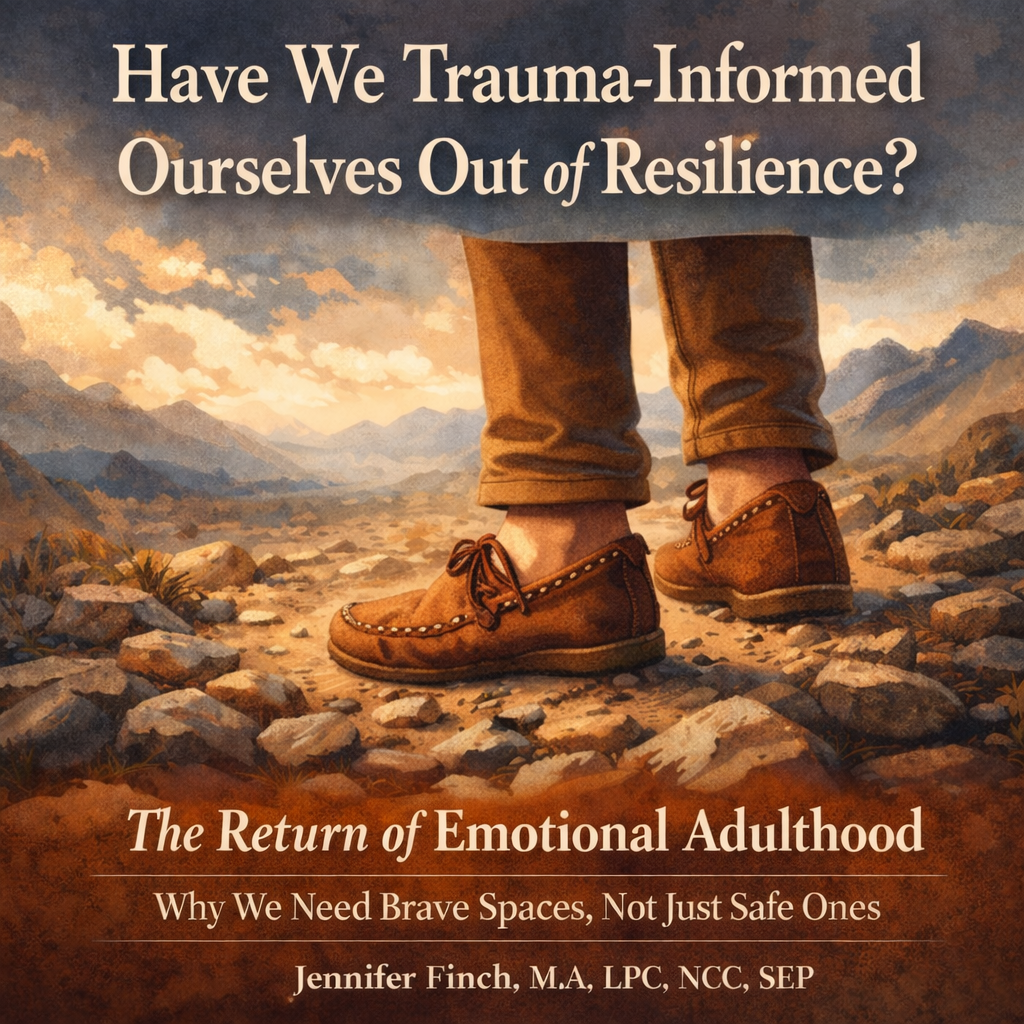
Putting Your Own Moccasins On
I want to begin with a parable that has guided my work through the decades, and it feels especially relevant here. It comes from the 8th-century Buddhist teacher Shantideva.
The story goes like this: a king, frustrated by the sharp stones and thorns on the roads of his kingdom, orders that all the land be covered in leather so his feet will never again be hurt. His advisors gently point out the impossibility of such a task—the cost, the scale, the futility of trying to cushion the entire world. One wise voice offers a simpler solution: rather than covering the earth in leather, place leather on the soles of the king’s own feet. Then wherever he walks, the ground will be bearable.
The teaching is simple but profound. We can spend our lives trying to soften every external condition, arranging the world so it never provokes, never pierces, never unsettles. Or we can develop the inner resources that allow us to move through a world that will always, and forevermore, contain sharp edges.
This shouldn’t be news. Mother Nature herself is not particularly interested in our comfort. She is magnificent, yes, but also unsentimental. Life was never designed to be padded. It was designed to be met. The strange paradoxical gift in that reality is that the human spirit grows strong by learning how to stand in the harsh winds, not avoiding them. And when we strengthen our own footing, we carry stability with us. We are no longer dependent on perfect conditions outside ourselves in order to function, learn, or remain open.
An author and therapist, Krissy Pozatek, once translated the above parable in a way that landed immediately for me. She described it as “putting on our own moccasins.” The phrase captures the same wisdom of Shantideva in everyday language.
Rather than demanding that the terrain be endlessly covered in leather or tirelessly trying to get the world to conform to our own ideals and preferences, we build the capacity to walk across it with surefootedness, without needing any disclaimers. Life doesn’t come with trigger warnings. So, trying to bubble-wrap the entirety of it becomes futile.
The Peril of Safetyism
The moment we walk out our front doors, we enter a world that has never promised safety. Life may not have intentions to be cruel, but it is definitely unpredictable, textured, and forever moving. It is alive. To acknowledge this is not an act of pessimism, self-denial, or forced toughness for toughness’s sake. It is a way of cultivating agency, resilience, and a felt-sense of safety within. And to stop seeking it from “out there.” Because you can look all you want, but it isn’t out there. My guess is that you already know and feel this. This is not stated with malice; it is offered as a form of sobriety. A nudge into waking up. This is essential for maturation to occur. Otherwise, we risk remaining in a kind of cultural arrested development.
Many contemplative traditions have long suggested that the ground beneath us is not solid in the way we would prefer. Everything moves. Everything changes. People disappoint us. Circumstances shift without warning. When we stop insisting that the world arrange itself around our comfort, something interesting can begin to happen. We shift from seeking safety “out there” to discovering safety within ourselves. We move out of the current cultural movement known today as Safetyism—a manufacturing or engineering of safety in every outer condition.
My hope is that we begin to move toward a more realistic development of safety within ourselves. Something that is more stable, reliable, felt, and independent of anything that is constantly shifting. My hope is that we begin to make a small cultural adjustment here. Instead of pointing ourselves outward to find and secure safety, can we turn inward? What would the world look and feel like if we deliberately trained ourselves to develop steadiness within our own nervous systems, so we can remain present even amid distress? If we trained our minds to stay open and curious even in the midst of suffering, and trained our hearts to remain open even when they encounter or are asked to endure a little friction? To me, this is real resiliency. But the work is self-owned. Not requested by anything external, imposed by the world around us, nor demanded or expected from anyone outside ourselves.
Without that shift, I fear we will spend an entire lifetime waiting for the environment, or for others within our environment, to become perfectly accommodating before we feel okay. And when that happens, our development will inevitably stall. Counter to what we might like, growth requires contact with the very hard conditions we might be trying so hard to avoid or take personal responsibility for.
If we continue to coddle, aren’t we in fact clipping wings? What the research says.
If we keep cushioning every fall, censoring our language to eliminate “all” possible trigger words (even the ones no one can actually predict), at some point we have to ask the obvious question: Are we helping individuals grow, or are we hindering them? Are we cultivating resilience and helping individuals ground themselves in reality, or are we trying to pad the world so much that individuals never develop the strength to move through it?
The uncomfortable answer is the latter.
Research has been pointing in this direction for decades. One British educator in the 1990s tracked a group of children raised with virtually no limits—no chores, no bedtimes, no meaningful “no.” Their parents believed they were cultivating independence and strong, free-spirited voices. They wanted free thinkers, children who felt empowered to express themselves.
What emerged instead was something far more brittle and quite devastating. Without boundaries, these children never developed the internal scaffolding needed to meet the ordinary friction of life. Consequences, it turns out, serve an important biological function. They act like resistance training for the brain’s learning systems, particularly the basal ganglia, which help build habits and regulate behavior. Without the steady weight of uncomfortable limits, those systems never had a fighting chance to strengthen.
As it turns out, a mind raised without resistance can function beautifully in a padded, protected, and cushioned environment, but virtually nowhere else. And, I want to be very clear about something, so I will emphasize in all caps: COVERING THE GROUND WITH LEATHER IS NOT SECURE ATTACHMENT. Increasingly, the language around attachment and safety is becoming blurred.
Secure attachment, in its truest form, prepares a child for the world as it is—not by shielding them from life’s edges, but by helping them discover that they can meet those edges and remain whole.
If we offer endless protection, idealized notions of safety, and cushioning from hardship, it confuses the child because the dichotomy between the ultimate safe environment in which they are being raised and what they experience in the real world is so starkly polarizing. If the nest is so secure, they will never leave it. This may also help explain why some young adults struggle to leave the psychological safety of the nest.
When every rough edge is removed, something essential erodes. The child begins to live inside a carefully engineered bubble of comfort, while the actual world continues to operate under entirely different rules. And the gap between those two realities will only widen as they experience more in their lives.
Philosophically speaking, this creates a kind of existential whiplash. Inside the bubble, everything is endlessly negotiable. Outside it, gravity still works. Deadlines still exist. Other people have their own needs, their own boundaries, their own rough edges.
So, when a child grows up without ever encountering those limits in a supported way, the world can feel not merely difficult, but bewildering—almost hostile. Not because the world suddenly became cruel, but because they never learned that friction is part of the structure of reality.
Hardships and suffering to some degree are inevitable in every human life. So secure attachment would be helping a child learn again and again that they can encounter difficulty and still remain connected to themselves and to others. It is therefore cultivated by and mirrored in a steady presence of a caregiver who can help a child metabolize frustration, disappointment, intolerance, and limits without being crushed by them.
Secure attachment does not mean the world bends to accommodate a child’s every discomfort. Yet this is increasingly the pattern many of my colleagues and I are witnessing.
What begins in the home does not stay there.
The demand and expectation that discomfort should be eliminated rather than navigated is showing up in classrooms, on college campuses, and even in professional training environments where I teach and learn alongside other adults.
More and more often, thoughtful and well-intentioned participants arrive with a sincere but growing request that the space be made completely safe and that edges be softened in advance. That certain words be avoided. That tone of voice be slower, or somehow more soothing. That difficult topics be softened or carefully filtered. That ideas be pre-screened. That the atmosphere be curated so that no one feels unsettled. That slides or video enhancements for teaching purposes are muted down or PG-rated. That deadlines be generously extended.
The impulse and intention behind this is understandable. Many people carry real wounds, and no one wants to casually reopen them. Compassion, at its best, asks us to be thoughtful with our impact on others. And where we can utilize non-violent communication, we absolutely should. My goal when I teach is to genuinely want to create an environment that is considerate and humane. But lately, even this doesn’t seem to be enough.
There is a delicate line here that deserves attention. When safety is interpreted to mean the removal of all discomfort, or even to shrink the teachers or teachings that will cultivate readiness, we begin asking the world to operate in ways it simply cannot sustain. Conversations about complex subjects—trauma, relationships, identity, gender, power, love, responsibility—will inevitably brush up against strong feelings. Language will sometimes land imperfectly. Ideas will challenge assumptions. None of this is a failure of care; it is often the very terrain where learning occurs. Humans are not infallible; we all come with many limitations, flaws, and inadequacies. I know I have plenty.
Going back to the study…
If we overlay this back onto the study I mentioned, the significance of this becomes heartbreakingly clear.
By adulthood, the outcomes for the children studied who had zero consequences were sobering. Many of the participants struggled to tolerate ordinary feedback at work. Several left their first jobs within months after routine constructive criticism, something as minor as a supervisor questioning formatting choices. Others became overwhelmed and panicked when deadlines weren’t extended or expectations held firm. Their nervous systems had never been trained to metabolize pressure. And their brains became a “mental jelly” when they bumped up against the slightest intolerances of the real world.
The same pattern showed up in relationships. Partners described conflicts that escalated quickly. Instead of negotiation or repair, these adults tended to withdraw entirely or attack. Accountability felt intolerable because it had never been practiced. They also didn’t have great role models showing them how to withstand conflict, stay present, and work through it to the other side.
And anyone who has actually stayed in the room long enough to do that kind of conflict-oriented work knows something important. When two people make it through conflict without abandoning themselves or each other, something incredibly valuable happens. Intimacy deepens. Respect grows. Our tolerance for difference expands. The relationship becomes sturdier, not weaker.
So, perk your ears up on this: working through friction doesn’t destroy connection. More often, it’s exactly what builds it.
The conclusion of the study was strikingly simple. Boundaries are not acts of restriction. They are structural supports and load-bearing walls for the developing self and the psyche. A childhood without them may feel protective and gentle in the moment, but it leaves a person dangerously underprepared for life’s normal demands. The biological cost ends in a sort of devastating, invisible paralysis.
So to the parents, teachers, educators, trainers, coaches, and the many stewards of human development: the ones who can calmly embrace uncertainty and discomfort and teach from there, are doing something far more generous than it may appear. They are shaping the adults who will one day stand upright in their own lives. People who can meet disappointment, conflict, or responsibility without crumbling, fleeing, or harboring resentment have learned resilience. They are the ones who will thrive and flourish and have overall well-being. And they are the ones who have developed the capacity to live fully among other imperfect beings and not have it rock their internal boats.
A Telling Example
I will end here with a small but revealing example. One that captures the question behind the title of this piece.
A college professor once described a student who asked that the word deadline not be used in class because it felt violent. The professor agreed and began substituting phrases like “submission date.” Within weeks another student objected to the word submission because it sounded oppressive. Soon the class was negotiating language the way diplomats negotiate borders.
Meanwhile the assignment itself still had to be finished.
What began as an effort to protect sensitivity and be more trauma-informed slowly turned into something else. A room full of highly intelligent adults spending more energy managing discomfort than building the capacity to tolerate it.
I have encountered similar dynamics in professional training spaces (I train trauma therapists and frontline healthcare providers). Before a discussion even begins, participants ask that certain words be rephrased, or removed from the conversation, or that topics be approached only through very narrow language so no one feels activated, unsettled, or uncomfortable.
Although these requests are usually sincere and thoughtful, they can create a dilemma in which thoughtful care unintentionally slides toward quiet forms of censorship. I understand and fully support people trying to care for one another. I also agree that much of our language should be updated, evolved, expanded, and brought into our modern era.
But what I am pointing out here is what is happening more subtly. When we begin designing environments where discomfort itself becomes the problem to eliminate, we are slowly becoming organized around avoidance rather than growth. We are shrinking resilience. Not maturing or expanding our window of tolerance.
If our conversations grow cautious, and our language tightens on a rope, then participants begin to monitor one another for potential missteps. Hypervigilance itself becomes even more hypervigilant. And in trying to protect everyone from distress, we may be removing the very conditions that help people develop strength, perspective, and emotional range.
Trauma-informed care was originally meant to deepen compassion. It helps us understand how pain shapes and organizes our bodies and how healing environments can support recovery. And that insight has been invaluable. The goal was never to eliminate every sharp edge. If there ever was a goal, it is towards recovery, healing, and ways to help people discover they can meet those edges of unpredictability, sometimes difficult, and occasionally painful life circumstances, and still stand. And that is deeply meaningful.
But if we are not careful, the pendulum swings, and we will drift far from our centered, balanced goals of resilience. This raises my titled question: Are we trauma-informing ourselves out of resilience? Are we cultivating a culture where the presence of discomfort is treated as harm itself?
I believe we are capable of encountering pressure, uncertainty, even disagreement, and remaining intact. In fact, from my own experience, that is precisely how a self develops. When we stop trying to engineer flawless external conditions, we offer something far more valuable: the chance to build an inner steadiness that can move through an imperfect world with curiosity, creativity, non-attachment, strong differentiation, and fluid vitality.
So when we resist cushioning every experience or contorting ourselves to manufacture perfect safety, we are not failing anyone. We are preparing them. Preparing them to stay present when life presses in, to remain in conversation when difference appears, and to tolerate the ordinary friction of being imperfectly human together.
Perhaps what I am really pointing toward is a return of emotional adulthood. A shift into a brave space that does not promise comfort and only speaks in terms of relative safety. Not absolute. A brave space is not a hardening of the heart. It is a maturation of it. It allows ruptures and repair. It allows mistakes and recovery from them. It tolerates otherness.
Life does not arrive pre-edited. And resilience does not grow in perfectly controlled conditions. Managers will continue to give blunt feedback. Friends will continue to say clumsy things. A partner will miss the point entirely. A stranger on the internet is spectacularly unhelpful or even dangerous. The world will never cooperate with our attempt to remove every possible point of friction or even egregious harm.
So, our resilience requires something more. It requires learning environments and home environments that foster the development of a mind capable of distinguishing intent from impact. We need support in cultivating a self that can absorb the ordinary collisions of life without interpreting every one of them as trauma. Because without that capacity, people do not become safer. We actually risk becoming more fragile than we truly are.
And fragility, ironically, is the very thing the culture of protection is trying to prevent. And perhaps, in this moment of cultural tension and uncertainty, what we need most is not perfect safety, nor a trauma-informed culture that unintentionally shrinks our capacity to meet life’s hardships, but the self-actualizing return of adults who know how to stand in the room together and face life as it actually is.