ESSAY — SELF & OTHER Who Am I Without the Other?
On the erosion of self-other distinction, the science of burnout, and the ancient art of knowing where you end, and another begins.
By Jennifer Finch, M.A., LPC, NCC, SEP
May 13, 2026
THE ISLAND
Wilson, We Have a Problem
There is a moment in Cast Away that most people remember for Tom Hanks’ anguish. His volleyball, the only relationship he has left on the island, drifts away on the tide, and he mentally loses it. He becomes inconsolable—for a ball with a painted face on it.
We might even laugh a little at this part, because it sounds absurd when you really think about it—but if I’m being fully honest, I also cried. Wept might be more like it. What struck me the most was when I questioned what exactly he was mourning. It wasn’t his aloneness or being stranded on the island. It wasn’t even the volleyball—the simple object you bump with your forearms over a net. He was mourning the last remaining mirror of himself. He was asking Wilson to tell him who he was. He was screaming for Wilson to stabilize him, to reflect the “me” back to himself, to keep him from disappearing. He needed Wilson to make him feel real.
We all know a volleyball is not supposed to hold a human identity together. But neither is our partner, nor our child, nor our profession, nor any role we happen to occupy. Wilson becomes such a powerful symbol in a self-to-self relationship. We learn that relationships give us feedback. We reach outward toward something or someone separate from us in order to experience ourselves as real. They provide a reflection, give contact, and provide a sense of solidity.
But the scene also reveals the danger hidden inside that truth. Human beings absolutely require connection, yet when too much of the self becomes organized around external reflection, identity grows increasingly fragile. This is known as a “reflected-sense-of-self,” where we literally cannot stand on our own two feet. We need constant feedback, praise, and recognition; to be seen, heard, and validated.
But this does not mean that in order to get our feet back under us, we are meant to become isolated islands of radical self-sufficiency either. The answer is not “need no one.”
Cast Away exposes how vulnerable the self can be when there is no internal ground underneath the relational mirrors we depend on. It becomes blatantly obvious in this Wilson scene how the illusion of a stable identity quickly deteriorates once both self-to-self and meaningful self-to-other connections disappear. Wilson was not a friend. Wilson was a function—the function of being witnessed. And without witness, something in Chuck Noland (Hank’s character) was dissolving. Identity, it turns out, is not a possession we carry around inside us like a driver’s license. It is more like a fire that needs oxygen. One needs the other to feel they exist.
The self does not arise in isolation. It arises in the space between—in the charged field of contact and response, recognition and repair. Quite frankly, we will never know what it is like to be without a relationship because we were born into one—even if it wasn’t a great one. Because even the worst forms of relationships still somehow define us and make us who we are.
***
Now consider that we are not on an island—most of us aren’t anyway. We are surrounded by more people, more stimulation, more alleged connections than any generation in human history. And yet reports of loneliness, disconnection, and identity diffusion are at historic highs. Something is happening to the self-other boundary. Something is shrinking us—and our sense of self. Are we farming it out to too many external sources? Are we wobbling around on a reflected-sense-of-self?
The movie exposes, maybe even accidentally, something deeply true and uncomfortable about human beings. Much of what we experience as “self” is stabilized through relationships with other people. We know ourselves partly through reflection, partly through response and feedback, and partly through attachment. If we remove those relational mirrors long enough, something profoundly disorienting begins to happen to the psyche.
This becomes especially important in a culture increasingly organized around both hyper-connection and emotional avoidance. We are more visually exposed to one another than perhaps at any other point in history, yet many people have simultaneously lost the capacity to remain steady amid a relationship's constantly fluctuating dynamics.
We crave stability, consistency, and reliability. That is all great, if we can actually get those things. Most of us really haven’t. The more truthful conclusion is that relationships cannot survive without some discomfort—even if minimal, conflict—even if healthy, silence—even if in short periods, and ambiguity—because we are always in the unknown when we sit between two people. Yet, our tolerance for discomfort has narrowed, conflict feels threatening, silence feels like existential death, and ambiguity feels like unbearable dread. And so, people often oscillate between emotional fusion and emotional cutoff without realizing either extreme is still organized around dependency.
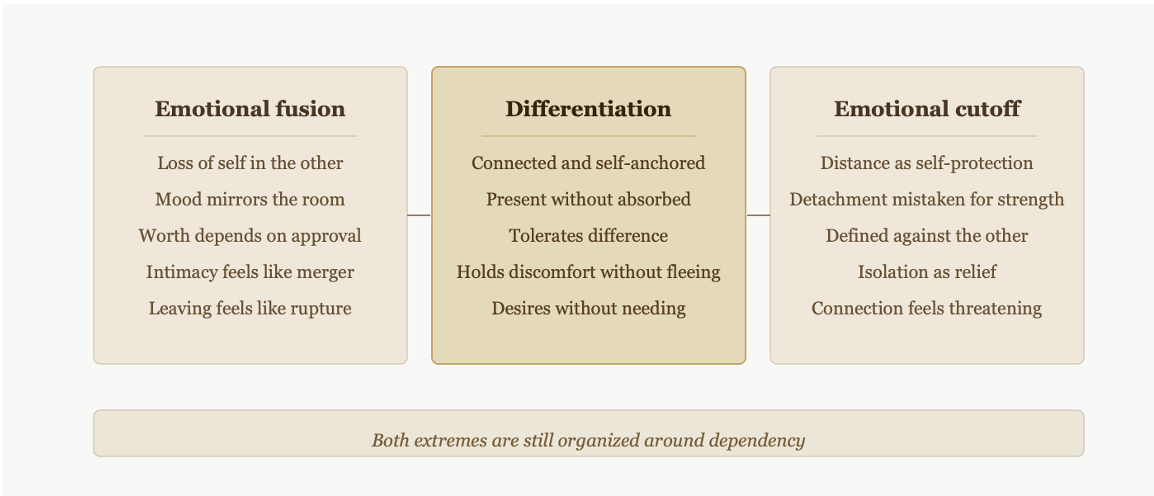
When relationships feel good, many people move beyond connection into absorption. They merge and lose contact with themselves inside the emotional atmosphere of another person or system. Their mood, stability, identity, and sense of worth begin organizing around the relationship itself. But when relationships become uncomfortable, as all real relationships inevitably do, many swing hard in the opposite direction toward emotional cutoff. Distance suddenly feels safer than any sort of naked vulnerability. Detachment becomes the new strength (even if it is falsified and only in appearance). Yet both fusion and cutoff share one thing in common: a fragile, undefined sense of self. In one, we lose ourselves inside the relationship. In the other, we define ourselves in reaction against it.
Most of us were never taught another way. A more balanced way where we cultivate a strong and flexible sense of self. A self that allows us to choose. We can rely on others, love others, and remain deeply connected, but without becoming entirely dependent on them for our stability, identity, or sense of worth. Most of us were not taught this kind of freedom. We existed in silos riddled with expectations on how to be.
We were not taught how to remain emotionally present without becoming engulfed in others, or how to tolerate distance, tension, disagreement, silence, and uncertainty without experiencing them as threats. We learned how to cling, adapt, manage, appease, dissociate, withdraw, or shut down, but not how to stay deeply connected while remaining anchored without our own interior steadiness. And because of this, many people move through relationships, alternating between absorption and avoidance, never quite realizing that both positions sever them from themselves while also disconnecting them from the connection to others—the very thing we might need or be seeking.
And perhaps this is why Cast Away feels far more psychologically accurate to me. Remove sustained human relationships long enough and something undoubtedly begins to happen to the mind. We watch, at first, as Chuck tries to preserve himself through routine, structure, and order, almost as though maintaining the habits and rituals of civilization and ordinary life might keep him psychologically intact. But eventually even language begins to thin out, and time becomes increasingly distorted. With that, any sense of meaning goes out the window, and then, of course, Wilson arrives. He almost had to arrive, because at that point, there was no longer anyone reflecting him back to himself. There was no emotional orientation point—and it was devastating to watch. So who can blame him when this volleyball becomes emotionally indispensable? I am certain we all would have clung to our own Wilson if we were in that situation. In my own experience, I have encountered versions of this same phenomenon during long silent meditation retreats. Sitting in silence for prolonged periods can begin revealing how much of one’s identity is attached to relational psychological reinforcement.
At first, the mind reaches instinctively for orientation points: conversation, stimulation, productivity, identity, routines, phones, roles, plans, memories, fantasies, grievances, even the small familiar performances of personality itself. We start realizing how continuously we reach outward toward something else, anything else, to stabilize the inward experience of being “me.”
And when those reference points begin falling away, many people encounter something deeply unsettling. It can be, well, the opposite of peace—which is what meditation markets. In my first long retreat, I experienced restlessness, disorganization, anxiety, grief, and a host of other fluctuating currents. I will say, they get better and ease into peacefulness if you stick with it. But there is a strange realization that much of what we call identity is maintained through constant external references. Take them all away, and we are adrift, just like Wilson.
Eventually, you begin to notice how attached the mind is to being mirrored back to itself. To being known. Confirmed. Reflected. Needed. Witnessed.
The very vulnerable question waiting for everyone in the plumb depths of dark silence is:
If no one is responding to me, reassuring me, thinking about me, validating me, needing me, or reflecting me back to myself…who exactly am I then?
*It is important to recognize here that Chuck has not “gone crazy,” but Wilson has become emotionally significant because human beings are relational by nature, and we stabilize through connection. We locate ourselves partly through being held in relationship with others. And without that, our psyche will start to search desperately for something, in this case, anything, to organize around.
THE SCIENCE
What Neuroscience Knows About Us
The brain does not process “self” and “other” as cleanly separate categories. Research in social neuroscience has shown that the same neural circuitry (if you are a curious nerd: the medial prefrontal cortex, the anterior insula, and the temporoparietal junction) is activated whether we are thinking about ourselves or about people we are close to. The closer the bond, the greater the overlap.
Arthur Aron’s self-expansion theory, first introduced in the mid-1980s, states that close relationships literally expand our sense of self. Over time, people begin incorporating aspects of another person into their own identity—their perspectives, habits, interests, experiences, resources, social worlds, even ways of thinking and perceiving. In other words, the boundary between “self” and “other” becomes psychologically more porous in close attachment. In this view, we learn that the self is not nearly as isolated or fixed as we tend to imagine.
The timing of this theory actually matters culturally, because it arrived during a period when psychology was increasingly shifting from strictly intrapsychic models (“what is happening inside the individual?”) toward relational and systems-oriented understandings of human behavior. This is something that my mentor, Dr. Murray Bowen, and his foundational Family System’s Theory, had already been circling around for a long time.
What Bowen showed me went a step further than Aron. He claimed quite strongly, I might add, that expansion without differentiation is not intimacy. It is merging. And merging, in the psychological sense, is the catastrophe at the very center of burnout, codependency, and chronic relational dissatisfaction. There is a blatant loss of self when we merge. This is fertile soil where resentment builds, where we say things like, “I have to get away from you in order to be me.” Or, “I have to quit my job in order to recover and be healthy.”
There is a danger in becoming so emotionally fused to another person, family system, institution, ideology, profession, or community that we can no longer distinguish our own thinking from the emotional field surrounding us. Murray Bowen believed that poorly differentiated people begin absorbing the anxieties, beliefs, reactions, and emotional processes of the systems around them almost automatically. Over time, the self becomes less internally directed and more environmentally determined.
This does not mean people lose intelligence. Often quite the opposite. They become highly adaptive, highly perceptive, extraordinarily skilled at reading a room. But adaptation is not the same as arriving at selfhood or the maturation process that gets us there.
The danger is that eventually thoughts, opinions, values, even emotional reactions may no longer emerge from genuine reflection, but from emotional pressure to conform within the system itself. The family thinks this way. The church believes this. The profession rewards this. The partner needs this. The community punishes that. The news tells me this. And slowly the individual stops asking a much deeper and necessary question: What do I actually think? What do I actually feel? What is truly mine here?
Without healthy skepticism, serious fact-checking, or our own discernment weighing in, we quite literally can and will believe anything—and this is a very slippery slope in this unstable world, force-feeding us endless content. We become extraordinarily vulnerable to absorbing whatever emotional field or ideological current happens to surround us. With streams of information, opinion, outrage, and blowhard certainty, the capacity to think from an internally grounded place becomes increasingly fragile. We can quite literally begin borrowing our thoughts wholesale from the systems around us without ever pausing long enough to ask whether something genuinely resonates as true within us.
And I recognize the irony here as I write this essay itself. Every voice influences us. Every perspective leaves some imprint. That is part of being relational beings. But there is a difference between allowing ideas to inform us and allowing them to entirely organize our reality for us. A healthy self can listen deeply, remain open, be moved, challenged, expanded, even changed, while still retaining the capacity for discernment. For reflection. For an internally anchored sense of knowing. Otherwise, we become psychologically unmoored, endlessly shaped by the loudest voice in the room, the algorithm, the family system, the news channel, the community, the ideology, or the collective anxiety of the moment.
***
Bowen understood that one of the central tasks of adulthood is developing the capacity to remain in meaningful emotional contact with important others without surrendering the integrity of one’s own mind in the process. Because whenever the self becomes entirely organized around belonging, approval, harmony, or emotional survival within a system, something essential begins to disappear. In every case, we have lost more than our ability to think for ourselves; we have lost our whole Self.
This is where Murray Bowen’s concept of differentiation becomes incredibly useful. Differentiation describes one of the central developmental tasks of being human: how to remain deeply connected to others without losing access to yourself.
When we merge, Bowen family systems theory calls this fusion. Fusion, or enmeshment, is the degree to which an individual’s emotional functioning becomes entangled with and reactive to the emotional state of those around them. The poorly differentiated self loses its footing the moment the relational environment shifts—and it will most definitely shift. In fact, it is always shifting. There will not exist a world where the boss never becomes terse. We will inevitably do something that will cause our partner to withdraw or vice versa. In fused systems, anxiety runs contagiously like a virus, and suddenly, we do not know how we feel—only how the room feels. Which determines how we feel without our direct input.
Many of these relational patterns are inherited, some of which are unconscious, and some of which are conscious but never spoken about. Those who tend toward the fusion end of the spectrum often come from previous generations organized around fusion. Somewhere along the line, someone learned to manage the emotional atmosphere of the family in order to preserve attachment, stability, or survival itself. Some became caretakers of the enormous and often ambiguous emotional field, monitoring moods, tensions, reactions, and unspoken undercurrents with astonishing precision. Some became adapters, shape-shifting around stronger or extreme personalities or unstable systems.
Others moved in the opposite direction and became emotionally self-sufficient to the point of isolation. They learned not to rely on the anxious system at all and attempted to cut themselves off from it entirely—physically, emotionally, geographically, psychologically. But emotional cutoff is rarely true freedom. The nervous system often still carries the full weight of the unresolved entanglement, even from a distance. People can move across the country and still remain emotionally organized around the very system they believe they escaped.
And some of the more sensitive among us become chronically fused with the moods, needs, distress, and approval of others, living in a near-constant state of emotional orientation toward the external world. Most people move between these positions depending on the relationship, the level of stress in the system, and how much internal steadiness they have available in a given moment.
THE COLLAPSE
How We Lose Ourselves
In the workplace
I see this constantly in helping professions. Therapists, nurses, physicians, teachers, caregivers—people whose work requires sustained attunement to the emotional and physiological states of others. Over time, without a strong self-other distinction, empathy runs into over-identification. We begin to define our worth through the worth of our role. Our identity becomes: the one who delivers, who fixes, rescues, or solves the problems, the one who is always available.
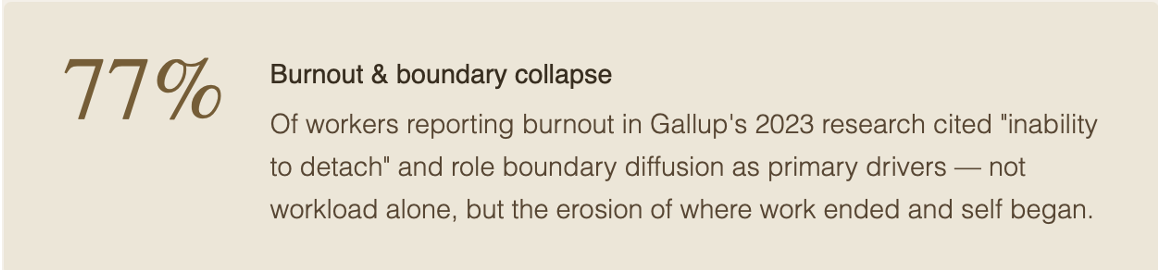
The organization’s nervous system becomes their own nervous system. They have collapsed into it and started organizing themselves around every external distress signal. Any urgency in the whole system becomes their own urgency. Any mood or anxiety in the entire system becomes their mood or anxiety. Their interior life becomes seriously overcrowded with everyone else’s experience. They start staying later and later because leaving the system starts to feel like a rupture in the very relationship they cannot name. I mean, how can you have a relationship with a system? Or a job?
Eventually, people no longer know how to come back to themselves because they have spent years orienting outward. This is not dedication. And this is also a reason why burnout feels so much deeper than simple exhaustion. Often, what burns out is not merely energy, but coherence.
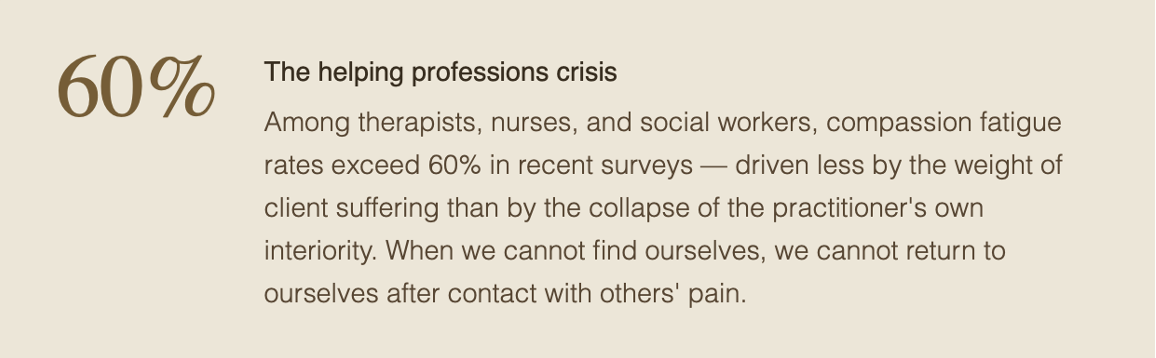
And because our culture frequently praises self-abandonment when it appears compassionate or “hard-working,” many people do not recognize this collapse until the body begins forcing the issue through anxiety, panic, numbness, resentment, illness, fatigue, emotional withdrawal, or even suicidality.
In an intimate relationship
We might begin to shape-shift to preserve connection, and we swallow our preferences to blend in and go with the flow. We mirror the other’s mood, or fight tooth and nail to stay out of it. We anticipate movements, moods, and distress calls, and walk on proverbial eggshells, becoming expert translators of what the other needs. All while staying amateurs at knowing what we, ourselves, need. The relationship feels like oxygen—essential, life-giving, and impossible to live without. But somewhere along the way, the emotional system contracted, and the room became very small in an Alice in Wonderland kind of way. There is less and less oxygen in the space to actually breathe. There is less room for difference, spontaneity, individuality, or even a thought. Disagreement might blow the roof off, so we never take the risk. And eventually, people find themselves in the strange position of depending on the very dynamic that is slowly suffocating them.
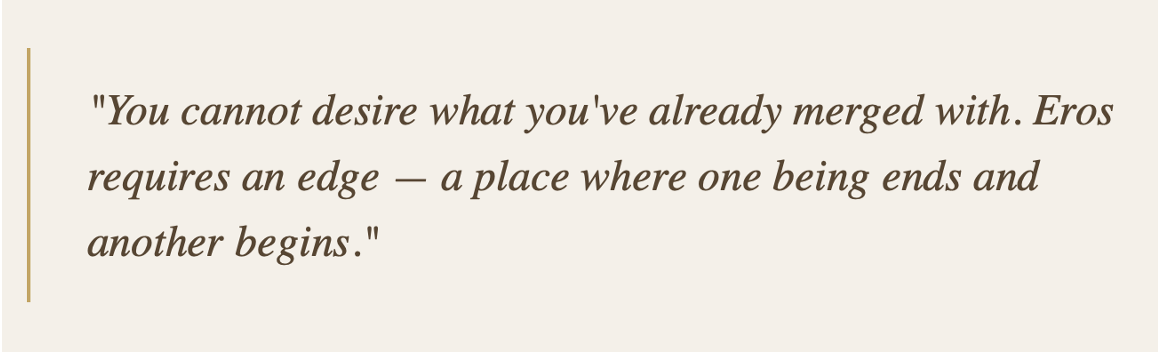
A hallmark is the death of desire. Sometimes desire decreases out of malice, spite, resentment, or disgust, but mostly through dissolution. You cannot want someone whose shape you have already become. Intimacy requires two people present—two desirably different people. And fusion, however warm and close it may feel, reduces the headcount.
THE REPAIR
Differentiation Is Not Distance
This is the single biggest misunderstanding that undermines every attempt at boundary work. Differentiation is not the act of caring less, withdrawing, or building walls. And it is not cultivating a wider geographic space between self and other. If we move out of the country, our issues in our tissues will most certainly go with us. Differentiation is, in many ways, a practice of non-attachment. Not detachment in the cold or avoidant sense, but the ability to remain connected without becoming psychologically entangled in every emotional movement around us. We begin learning how to loosen our grip on the constant need to manage, absorb, fix, secure, or control the relational field, while still remaining fully rooted in ourselves. We work toward not allowing another person’s emotions, reactions, distress, approval, or disapproval to completely sway our sense of self. The emotional atmosphere existing within another person does not have the power to entirely dictate, destabilize, or reorganize our own interior ground unless we grant it that power.
And paradoxically, this often requires risking the discomfort of disconnection. We have to tolerate the possibility that another person may not like our boundary, our honesty, our difference, or our separate reality. We have to survive not being perfectly mirrored, approved of, or emotionally fused in order to discover that the self can remain intact.
At the same time, those who have organized themselves around rigidity and distance face a different task. They must learn how to soften toward the relationship again without experiencing closeness as annihilation. They have to train in how to stay open without feeling like they are going to be engulfed by the other. They must learn how to allow connection without surrendering the self entirely. Another person’s anxiety or reactivity or non-reactivity cannot determine the stability of the self —again, unless we grant it that power.
The movement is always toward balance: neither disappearing into the relationship nor barricading ourselves against it. Murray Bowen, who gave us the formal theory, described a well-differentiated person as someone who can remain in emotional contact with others while retaining a clear sense of self—someone who can hear your distress without becoming your distress, or my personal favorite—making your distress suddenly about them.
What fascinates me is how closely modern neuroscience and contemplative traditions converge around this age-old problem. Research on emotional contagion, mirror systems, predictive processing, and nervous system co-regulation demonstrates that human beings continuously affect one another physiologically. We are relational creatures all the way down to the body’s subtle, energetic level.
*The goal is not indifference. It is the capacity to be fully present with another person without losing yourself in the encounter—losing yourself by merging in, or trying desperately to stay rigidly separate.
Practice: The Returning Question
In any charged relational moment — at work, at home, in your own body — pause and ask: What is mine here? Not: what should I feel, or what would they want me to feel. Simply: what, in this moment, is actually arising in me?
This is the beginning of differentiation. Not a declaration of independence, but a small act of self-location.
Repair in the helping professions
For therapists, physicians, teachers — anyone whose professional identity is organized around care of others — the question is acute. We are trained to enter the other's world with exquisite sensitivity. We are rarely trained to find our way back.
Somatic practices help. Not because the body is wiser than the mind, but because the body is specific. It does not trade in abstractions. When you ask the body where am I? it answers with sensation — tightness here, openness there, a quality of ground or its absence. The body remembers a self that the mind has temporarily misplaced. Our training is to remain present while another person is distressed. To stay open without absorbing everything around you like a sponge. And to care deeply at a human-to-human level without organizing your entire identity around being needed, or included.
Repair in intimacy
David Schnarch spent decades arguing that one of the most loving things we can do for a partner is to stop contorting ourselves in order to manage another person’s emotional comfort. Let them have it, and thank God it is not yours.
We have to allow discomfort and not rush in to help it out, soothe, or pacify it. Differentiation has a requirement to be able to self-soothe. To manage our own suffering and find our own way out of it.
Any time we move from invitation into demand, something in the relationship constricts. The moment another person becomes responsible for regulating our emotional state, reassuring our worth, or relieving our discomfort on command, the connection itself will become forced, contrived, or flat-out broken. This does not mean we should become silent martyrs pretending to need nothing from anyone. Quite the opposite. Healthy relationships absolutely require honesty about needs, longings, disappointments, and desires. But there is a profound difference between expressing a need and demanding or expecting that another person erase our distress for us.
We can use the basic rule of Marshall Rosenberg’s Nonviolent Communication here and ask clearly for comfort, reassurance, closeness, repair, or presence without making another person responsible for our emotional survival. The other person remains free, including free in how to respond imperfectly. Or free to misunderstand. Free to say yes, no, not now, or “I do not know how.” And our task becomes learning how to remain connected to ourselves even inside that uncertainty. We can only make requests. We cannot blame, shame, or make demands. Unless we secretly don’t want the relationship to survive.
Real intimacy, the kind that deepens and does not suffocate over time, cannot be coerced. The more tightly we grip another person in an attempt to secure connection, the more the relationship itself begins to lose oxygen. Intimacy (in-to-me-see) requires two people capable of tolerating the separateness of the other, and two people willing to take responsibility for soothing at least some of their own discomfort rather than immediately handing it across the relationship. When people can remain connected without demanding sameness, constant reassurance, agreement, or emotional fusion in order to feel secure, something far more stable begins to emerge. To be truly known is, inevitably, to be revealed as distinct.
This runs counter to many romantic myths we inherited. “You complete me” may sound poetic, but psychologically, it can become disastrous. Much of what people call love is actually an attempt to escape the anxiety of separateness. We want the other to complete us, stabilize us, reassure us of our worth, remove uncertainty, soften loneliness, or protect us from ourselves. But no relationship can sustainably carry that kind of pressure. No person can carry the weight of becoming someone else’s missing self. We cannot dissolve into another person in the name of love without eventually losing contact with our own interior ground.
And paradoxically, eros is not destroyed by difference. It absolutely depends upon it. Attraction, vitality, curiosity, even aliveness and desire itself, require some degree of separateness. And separateness naturally causes a feeling of tension—until we expand and build capacity. The space between two distinct people is not a gap to close. It is the very condition that allows intimacy to remain alive. Because when two people collapse into one another psychologically, anticipating each other’s every move, eliminating uncertainty, smoothing over every edge of separateness, that kind of fusion may feel temporarily safe, but over time it will become emotionally claustrophobic. There is not enough space left to encounter the other person as truly other.
The recognition that another person remains partially unknowable, distinct, and sovereign unto themselves. Not fully possessed. Not fully merged. The people we love are not extensions of our own emotional system, nor are we extensions of theirs. They carry their own interior world, their own mind, their own anxieties, longings, contradictions, and private realities. Part of loving well is allowing another person the dignity of their separateness, while also reclaiming our own.
CLOSING REMARKS
Most of relational human suffering seems to unfold somewhere inside the tension: our longing for connection, and our fear of losing ourselves within it. We lose ourselves in two ways: either by fusing or by trying so hard to hold ourselves rigidly separate. Therefore, becoming a solid-flexible Self is the deeper repair work beneath so much of adult development. A self that can experience profound connection and shared humanity while still remaining anchored in its own individuality and separateness.
Which brings us back, strangely enough, to Wilson floating away across the ocean.
We are not mourning him exactly, but from where we sit now, perhaps a bit more differentiated and holding on to ourselves, learning what we think and how, we can notice what Chuck Noland discovered once the raft carried him back to safety—that he himself had been the constant. It wasn’t the relationship, or the approval, or the witness of the volleyball with the face on it. It was himself. That his wholeness had been there the whole time.
So my invitation to you is to begin with self-inquiry:
How much difference can I actually tolerate? How much uncertainty? How much discomfort? Can I remain emotionally present when another person disagrees with me, disappoints me, withdraws from me, misunderstands me, or simply exists outside the version of them I would prefer? Can I let another have their own mood without it becoming mine? Can they have their own opinions, biases, perspectives without it damaging the relationship between us? Can I tolerate otherness? If so, to what degree?
Differentiation is not measured by how spiritual, kind, regulated, or self-aware we appear to be, especially when everything feels harmonious. Differentiation is measured by what happens to our sense of self when a relationship becomes strained, uncertain, or emotionally inconvenient. When emotions run high and when the stakes are even higher, differentiation matters. Or we will get pulled in every direction the wind blows and become confused about who we are.
There is a surprisingly simple yet deeper inquiry underneath all of this:
Who am I without the other? Without the role? Without the work that needs me? Without being needed, praised, mirrored, reassured, or emotionally managed through someone else’s response to me?
For some people, the answer becomes rigid certainty: I do not need anyone. But often that is not differentiation at all. It is defended distance. Defending a self that is built through opposition and emotional cutoff. So you can start again by asking: Who am I without my anger or defensiveness?
For others, the answer is far more frightening: I genuinely do not know. Because the self has become so organized around external validation, approval, caregiving, achievement, or relational harmony that solitude feels disorienting, and silence leaves you feeling very exposed. In this case, there is no clear interior reference point underneath the roles and reflections. Don’t panic, that is all useful information. It means the work is not to go out and find yourself, because you are not “out there.” It means the work is to uncover the someone you already are—your separate self—standing right where you currently are. Right here, and right now, is the place where the work begins. You can start by asking: What do I think? (without the influence of anyone else’s thoughts or beliefs) —It’s harder than we might think to do this.
Most of us live somewhere between those two extremes, drifting toward one or the other end of the spectrum depending on the relationship, the season, the year. Fusion or cutoff? The goal is not to arrive at some permanent fixed point of selfhood. We will move consistently across this spectrum as various relationships require various adjustments. It is most important to remain flexible—but also to feel solid within our sense of self.
Start today by noticing where you are standing — and whether, when the room shifts, you shift with it entirely, or whether something in you remains. Good luck. And keep me posted on your discoveries.
For active workshops on learning how to somatically differentiate, visit my events page: www.beherenowmindfulness.com