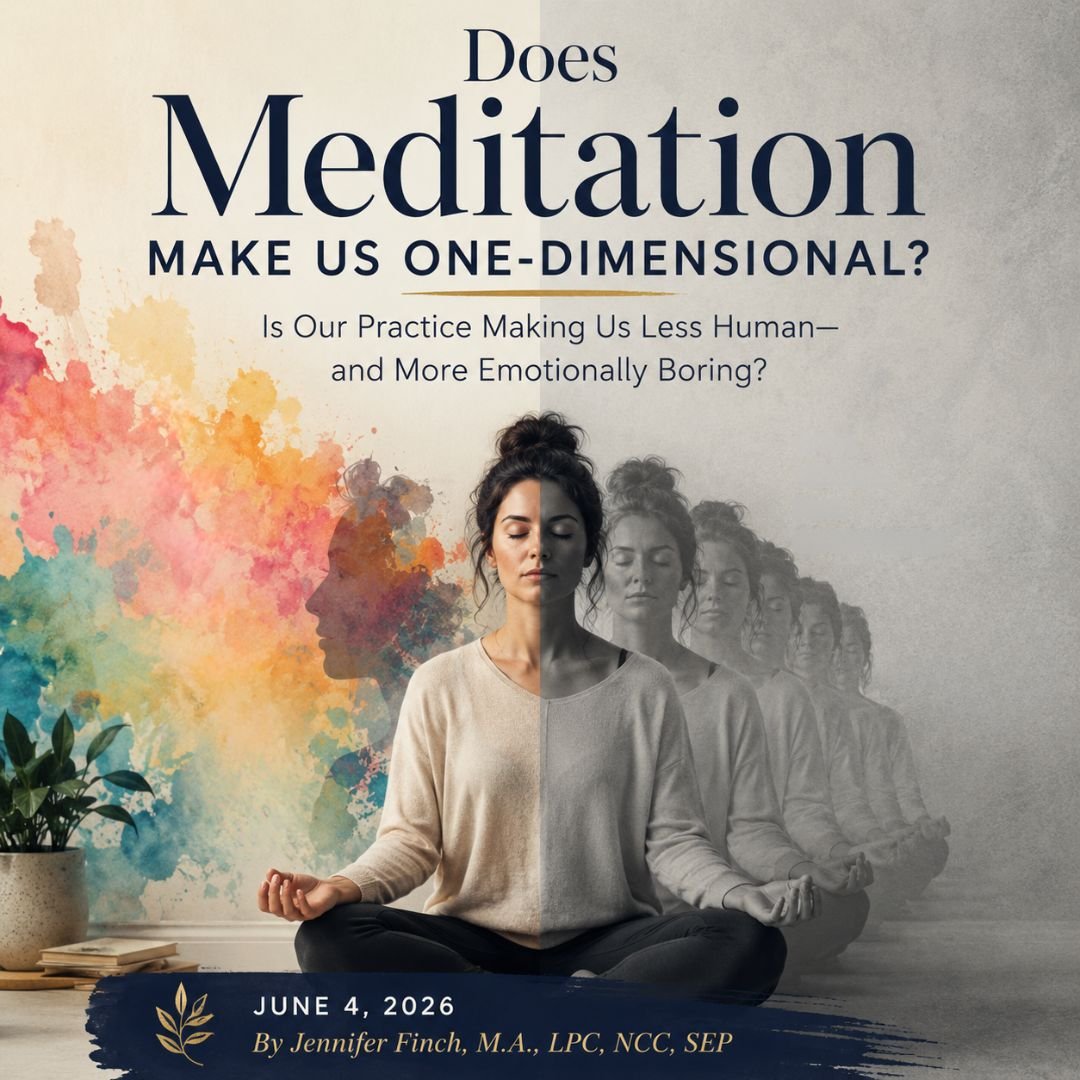
Does Meditation Make Us One-Dimensional?
Is Our Practice Making Us Less Human—and More Emotionally Boring?
June 4, 2026
By Jennifer Finch, M.A., LPC, NCC, SEP
A few weeks ago, I was listening to Ellen DeGeneres on SiriusXM comedy radio. The bit was titled, “No One in Show Business is Mean.” She was talking about the strange experience of becoming the public face of kindness.
For years, she ended every show with the same sign-off:
“Be kind to one another.”
Then, her image got complicated, the way public images do. Stories surfaced about difficult workplace dynamics behind the scenes, and the public response was swift and merciless. Suddenly, people seemed shocked that the woman who reminded everyone to be kind might also be impatient, demanding, frustrated, flawed, complicated, or occasionally unpleasant. Like every other human being who has ever lived.
Ellen joked that perhaps she should have ended every episode with, “Go f*** yourselves.”
That way, whenever she happened to be kind, people would have been pleasantly surprised.
I laughed harder than I expected to, because beneath the joke is something worth considering. We seem to prefer our public figures in one dimension. We want them simple.
The kind person.
The spiritual person.
The enlightened person.
The calm person.
The compassionate person.
The wise person.
We become uncomfortable when they reveal the entire rest of themselves. And nowhere is this more obvious than in the meditation and spirituality world. But I’m probably biased—because in truth it’s really everywhere.
But let’s spotlight the world of mindfulness for a second. Think about the teachers many of us admire. Tara Brach always sounds calm, measured, spacious. Sometimes, so measured that I find myself wondering if she has ever been irritated in traffic or yelled at a rude and impatient customer service agent. Jack Kornfield radiates compassion with such consistency that I half expect him to apologize to a mosquito before ushering it gently out the door.
To be clear, I am not suggesting these teachers are secretly raging lunatics behind closed doors. Quite the opposite. I suspect many have devoted their lives to embodying the values they teach. Some spiritual teachers truly are extraordinary examples of what years of practice can cultivate. Thich Nhat Hanh comes to mind. As do quite a few others. There are teachers whose lives seem remarkably congruent with what they teach. Their words and actions carry the same flavor.
After enough years in spiritual communities, though, I’ve come to trust congruence more than purity. Give me the teacher who occasionally reveals their humanity over the one who seems to have transcended it. And oddly, it isn’t the flaws that make me uneasy; we all have those. It’s when I can’t find a single contradiction that I start to get itchy. That’s usually about when I collect my things and go.
But for the ones we tend to trust and rely on, the truth is, we do not actually know them. We only know the version presented to us. The teacher. The poet. The peace activist. The author. The podcast host. We only know the specific, carefully edited hour they curated with intention, whether it arrives through our speakers or sits in front of us on a stage—that is all we see. Yet we base their entire personhood on that glimpse. As if what we see is all there is.
I know I do this too. On both sides of the equation. As a teacher, and as a student of many teachers.
When I walk into a room full of students, I am not planning to spend the first twenty-five minutes talking about the time I lost my temper with my son’s AP Human Geography teacher. Or when I snapped at my husband for playing golf when I chose instead to clean the filthy porch, and then got pissed about my own choices. I show up as the teacher. The version of me most relevant to why everyone gathered there in the first place. This isn’t deception. I believe it is just context.
But it does create an illusion. In much the same way that Instagram shows us vacations, promotions, glowing yoga instructors, and smiling family photos while conveniently omitting panic attacks, marital arguments, grief, and existential meltdowns.
If you only ever saw me teaching, you might conclude that I spend my days not worrying about much. Spending my days moving serenely from meditation cushion to therapy chair, pausing only occasionally to share curated wisdom about presence, compassion, or nervous system regulation.
You would then be disappointed to learn how much of my actual life involves negotiating with myself about whether I have enough energy to go to the gym and get a decent workout, or whether I am merely being optimistic and about to waste forty-five minutes half-heartedly wandering between machines while questioning why I went in the first place. You would not see my behind-the-scenes life, which involves teaching workshops on burnout while periodically realizing I need to take my own advice because I occasionally find myself suspiciously close to it.
My life involves many things. It involves irrational irritation toward my elderly pug, who has decided sleep is optional and that we should explore that possibility together at three in the morning—and unlike a newborn baby, he demands that I put pants on and actually go outside in the pitch dark. I routinely wander through my house peering through the wrong pair of glasses while searching for the right pair that won’t give me a headache, which often turns out they have been assisting in the search from the top of my head the entire time. My life, as I suspect yours does too, involves self-doubt, second-guessing, grief, anger, plants that need more attention and care than I currently give them, and piles of laundry that often resemble a national landmark, like Mount Rushmore. And of course, there are plenty of periodic moments that raise an exhausting number of existential questions, making me wonder exactly what I am doing with my life. On many days, I land in uncertainty, feeling inspired yet conflicted, wondering if I have anything left worth saying. And if I do, will it be too raw, too much, too candid, too in-your-face? The opposite of Zen.
In other words, it looks remarkably human. And none of which makes it into the meditation lecture.
We rarely get the whole person. We are only seeing selected dimensions of people, and after a while, we begin to compare our entire humanity to someone else’s highlight reel, measuring ourselves against a fantasy.
We assume the teacher is always teaching. The meditation instructor is always peaceful, calm, content, and internally happy. That the therapist effortlessly sees every human pattern, never gets hooked in dysregulation, and never loses perspective.
Years ago, I was on the phone with my Taoist teacher while he was driving. In my mind, he occupied a heavy chunk of the pie chart in the Zen category. He was wise, grounded, spiritually developed, and always smiling. I imagined that he moved through life with the emotional steadiness of a mountain. Then another driver cut him off, and without missing a beat, he muttered a profanity under his breath. I was genuinely surprised. What he said wasn’t particularly offensive, and in usual circumstances and ordinary relationships with my friends and family, this would have been the norm, and I wouldn’t have given it a second thought. But I was shocked by my own reaction. I had confused a role with a whole human being. Somewhere, I had crossed the wires unconsciously and decided that spiritual development meant never being irritated. Never being frustrated or argumentative. Never being human.
In reality, he wasn’t a Taoist teacher in that moment. He was a man driving a car. A man who had spent decades practicing awareness and presence, and who also found certain drivers annoying. The contradiction existed only in my mind.
I am happy to report that we remain good friends today. In fact, that moment only deepened my respect for him. It allowed me to stop relating to an idealized image and begin relating to an actual human being. Three-dimensionally. Our friendship became richer the moment I stopped expecting him to be anything other than “all-together-all-the-time.” Oddly enough, hearing him swear may have been one of the most valuable teachings he ever gave me. To be clear, I am not saying that I find profanity spiritually significant—although most of my midwestern family members might agree it is—I say this because it cracked the pristine, polished but flattened image, and perhaps that is what we are all longing for anyway. Permission to be fully human—not perfect. Or typecast as “the kind one.”
I see this narrowing of vision everywhere now. In my clients, my students, the people I love, and plenty of times in myself. We take the single slim slice of someone we happen to see and mistake it for the entire person, and then measure our whole messy existence against it. And naturally, we come up short.
People arrive convinced they are failing at meditation, or more broadly in life, because they cannot remain calm all the time. They firmly believe they should be regulated at all times. Patient all the time. Compassionate all the time. Zen all the time.
They might even imagine that spiritual maturity means becoming emotionally smooth around every single edge life bumps us up against. Meanwhile, they are deeply entrenched in the trenches of a human life: raising toddlers, caring for aging parents, managing demanding jobs, navigating marriages, worrying about money, grieving losses, and attempting to remain conscious while living inside a nervous system that evolved primarily to survive.
No wonder we feel inadequate. The problem is not that we are human. The problem is that somewhere along the way, many of us absorbed the idea that spiritual and/or psychological growth should make us less human. Modern mindfulness, spirituality, and self-improvement culture often reward a flattened version of humanity. The calm, regulated, symptomless, endlessly compassionate version. The version that responds wisely, speaks softly, never loses its footing, and somehow also remains centered while simultaneously managing the thousand daily frustrations of ordinary life.
I love meditation and the work I do. I have devoted a ridiculous amount of my life to sitting still, paying attention, studying consciousness, watching my mind, teaching other people to watch theirs, and generally pursuing what can only be described as a lifelong fascination with what it means to be alive and to be human.
This is precisely why I think we need to be careful here. Because I think we’ve misunderstood parts of these teachings. Especially if we are unknowingly participating in emotional monoculture, confusing awareness with emotional suppression.
A healthy human being is not one emotional note played forever. A full life cannot be lived only in a calm, soft, less reactive, less emotional, less messy state. Not all the time. To strive for that would be to become less human. So, we cannot mistake awareness for never getting upset. Compassion for never saying no. And peace for the absence of conflict. Regulation is not some unachievable mythical state in which nothing ever gets under our skin again. I don’t think that is the point.
These days, I find myself less interested in becoming calmer all the time and more interested in becoming whole.
Anger has a purpose. Not the kind that punches holes in drywall or terrorizes people, but a clean, clarifying force that rises up and can say, no, not this, this is not okay. It helps us establish boundaries and recognize injustice. It often gives us the energy to leave situations that are harming us and the courage to confront things we would rather avoid.
Grief has a purpose, too. Sometimes crying until your face is swollen and your shirt sleeve becomes a tissue is exactly what the moment calls for. And it feels good. To absolutely let go of control and fall apart for a while.
Conflict has a purpose. In adulthood, we learn a strange lesson and realize peace is not always maintained by avoiding conflict. Sometimes peace is maintained by having the conflict. By saying the difficult thing. By disappointing someone. And by refusing to spend another decade pretending everything is fine.
Fear has a purpose. So does joy, and frustration. Even uncertainty has its uses, much as I’d prefer otherwise.
The goal was never to become a caricature of serenity. Thank God. What a boring existence that would be. That, for sure, is one-dimensional and would turn us into a flat, Hallmark card with a perfectly regulated bird, paper-thin and perched on a textureless branch, touting some blasé inspirational quote.
The goal is to become capable of meeting all of it consciously. The full range. Without becoming imprisoned by any single part of it. This means we have to feel more. Express more. It means we have to take a chance and risk becoming more fully who we already are. Someone capable of experiencing it all—not just the parts that make us look chill.
The goal is to become whole and to see wholeness in others, even when they are teaching us on stage from one single aspect of themselves. Occupying for an hour or so, one of the many roles they have. So we mustn’t compare our backstage to their stage.
And whole people are too loud sometimes. They lose their patience. They cry in parking lots. They argue with their spouses. They get overwhelmed. They recover. They begin again. And again. And again. They occasionally say things they wish they hadn’t. Then they apologize. They recover. And they begin again—just like Thich Nhat Hanh taught us.
The deepest spiritual teachers I have known were never the most camera-ready and composed people in the room. They were the most real. Their humanity had not been scrubbed clean or edited out of them. Their practice had simply made them more available to it. Perhaps that is the invitation.
Not to become one-sided. Or permanently Zen and calm. Or endlessly nice. But to become spacious enough to hold the full range of being human. The tenderness. The grief. The joy. The heartbreak. The anger. The love.
The occasional desire to tell someone to go f*** themselves. And then, if the situation calls for it, to choose kindness anyway.