The Self–Other Distinction—Relationships and Compassion That Heal Without Losing Yourself
By Jennifer Finch, M.A., LPC, NCC, SEPAugust 28, 2025
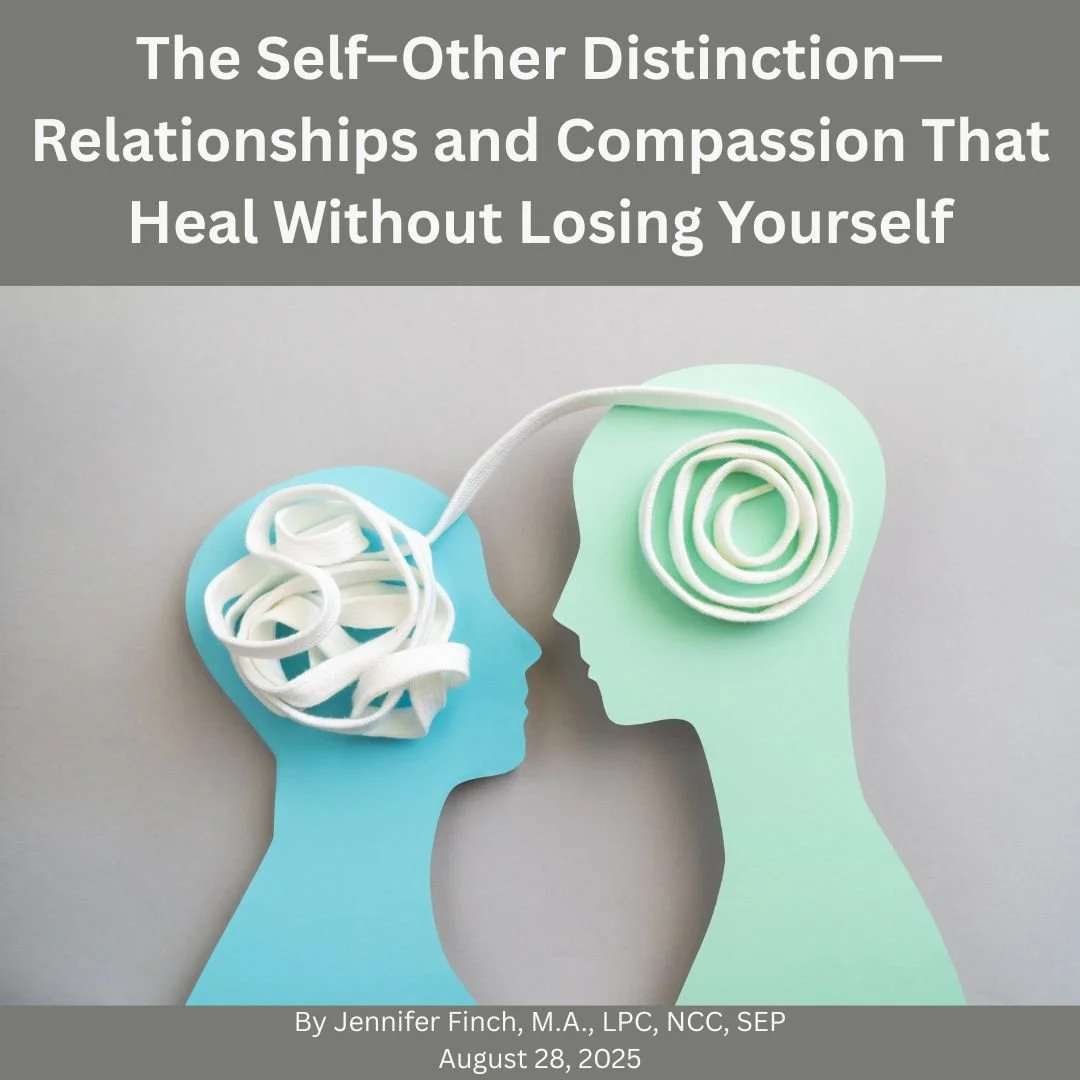
In the world of relationships, whether with our clients, our families, or our communities, the ability to hold the self–other distinction is one of the most essential skills we can cultivate. This distinction is the foundation of true compassion and differentiation. We cannot be mature adults without it.
It is imperative. And it is the single most important thing I work on with EVERYONE in my therapy sessions and teacher trainings.
If we don’t have and hold this distinction in our awareness, we risk losing our sense of self in the emotions, anxieties, and projections of others. With it, we can remain steady, clear, and present—able to respond rather than react.
This is everything.
The Neuroscience of Self–Other Distinction
Two brain regions help explain how this works: the periaqueductal gray (PAG) and the insula.
The PAG sits deep in the midbrain and is often associated with survival responses—fight, flight, freeze. But research shows it also fires during states of uncertainty, prediction, and when we “feel into” the distress of others. If we lack self–other distinction, the PAG can trigger a reactive cascade, pulling us into empathic distress rather than compassion. Instead of helping, we get swept up in fear, anxiety, or over-identification.
The Insula—sometimes called the “interoceptive hub”—maps our inner body states (heartbeat, breath, gut sensations) and also processes signals about the states of others. It’s where “I feel” and “I sense what you’re feeling” overlap. When the self–other boundary is blurred, the insula can’t effectively distinguish between my fear and your fear, leading to emotional contagion.
The gift is this: when we can clearly distinguish self from other, these same regions allow us to stay anchored in our own body while resonating with others. Compassion then arises as an open, embodied presence—not as fusion or overwhelm.
Why This Matters
Compassion without burnout and overwhelm: True altruistic compassion rests on this distinction. We can be with another’s suffering without drowning in it.
Differentiation in relationships: Holding onto ourselves allows us to remain clear, authentic, and responsive even when others are distressed or reactive.
Resilience in leadership and caregiving: Instead of merging with the environment, we stay centered, able to meet challenges with clarity.
Practicing Self–Other Distinction
Here are three somatic tools to strengthen this capacity:
Core Breath Awareness
Sit comfortably and bring attention to the subtle core of your body—from the top of your head through the center of your torso to your pelvic floor. Breathe gently along this axis. This anchors awareness inward so you can meet others from your center, not from collapse or fusion.
2. Boundary Sensing
Imagine a field of space just at the edge of your skin. Feel the gentle contact between your body and the environment. Notice: this is me, that is the world around me. Practicing this enhances the insula’s ability to track self and other distinctly.
3. Return to Sender Practice
When you sense that fear or anxiety you’re feeling may not originate from you, pause. Name it silently: “Not mine.” Breathe into your own chest or belly and allow what belongs to others to return. This interrupts emotional contagion and restores clarity.
Compassion doesn’t mean merging with another’s suffering. Compassion isn’t about jumping headfirst into someone else’s misery and drowning there with them. It’s about being grounded and steady enough in your own skin to stay open.
Relationships go off the rails when we either shrink ourselves to fit another’s frame—or inflate like a parade balloon and block out the sun. The point isn’t self-erasure or domination. It’s the strange and noble work of letting two minds, two bodies, two sets of needs actually coexist. Not one person’s hunger fed at the expense of the other, but both plates on the table. We need to grow and expand to accommodate this.
The neuroscience of the PAG and insula shows us that our biology is wired for this distinction—and our somatic practices help us embody and live it. When we hold the line between self and other, we not only protect our own well-being, we also offer others the gift of presence that heals.
Where in your life do you find yourself merging with others, and what shifts when you practice returning to your own body?